Powered Shell Acquisition: Pricing Unfinished Data Center Capacity in Atlanta
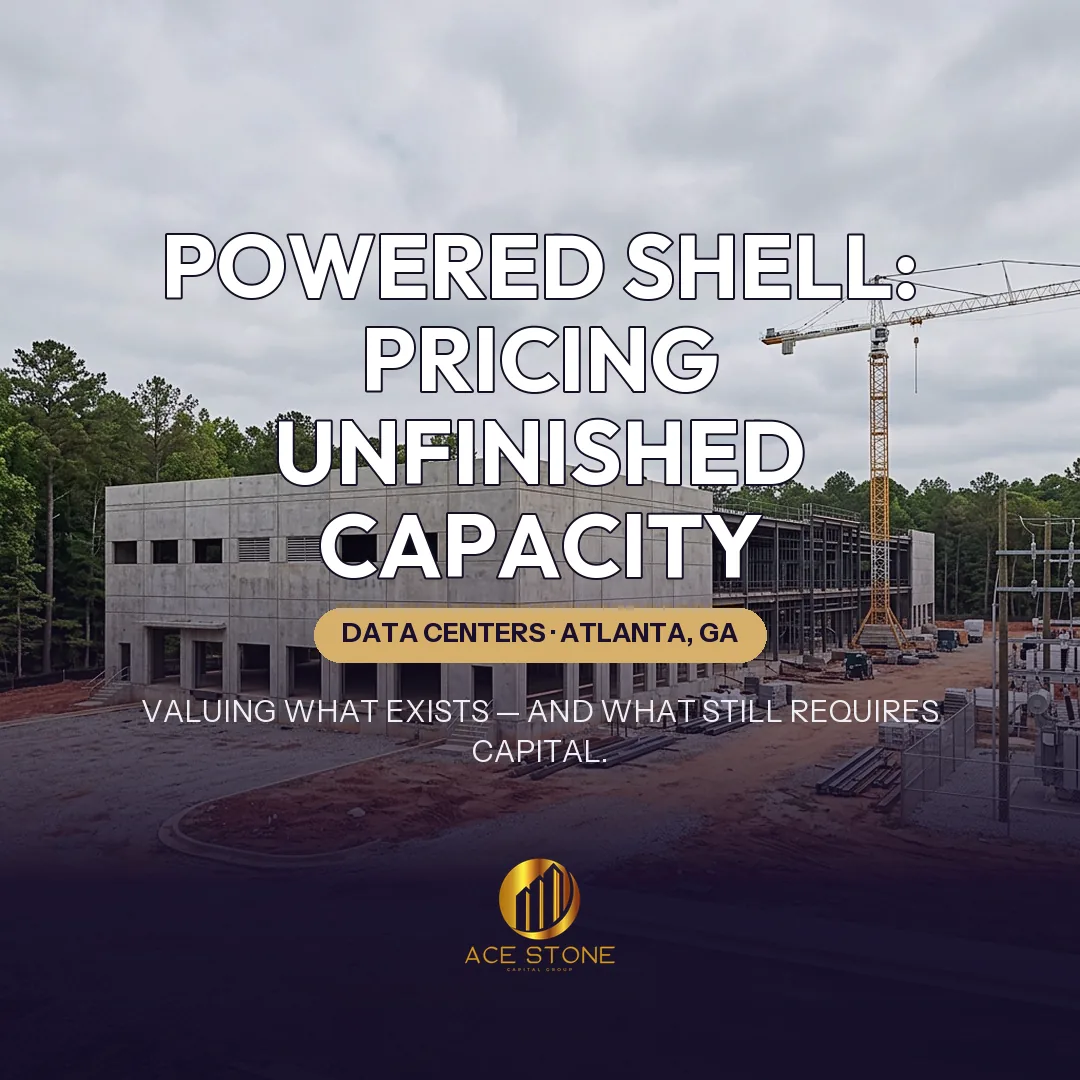
A partially completed Atlanta data-center project — separating the value of land, shell, installed electrical infrastructure and the remaining obligation to finish.
This acquisition profile examines asset strategy, underwriting method, transaction structure, and value-creation considerations. Counterparty and pricing details are not disclosed.
Representative imagery of the asset type and market — not a photograph of the subject property.
Case Context
This acquisition profile examines AceStone Capital Group's underwriting method for an asset of this type. Specific properties, counterparties, and pricing are not identified. The subject profile is a metro Atlanta data-center development that stalled after the shell was topped out and a portion of the electrical infrastructure was installed. Powered shells are commonly marketed as capacity available at a discount to new construction. The underwriting task is to determine which components genuinely carry value and which represent sunk cost that transfers no benefit to the next owner.
Decomposing the Asset
The analysis values the project as five separable components: the land and its entitlements; the building shell and site improvements; the electrical infrastructure physically installed; the utility position, meaning the capacity commitment and interconnection status; and the completed portions of mechanical, life-safety and security systems. Each is valued on what it saves a completing owner in cost and time, not on what the prior developer spent. Sunk cost is a fact about the seller's basis and carries no independent weight in the buyer's model.
In most powered-shell transactions, the utility position is worth more than the concrete. The analysis establishes what capacity has been contractually committed, whether that commitment is assignable to a new owner and on what conditions, what has been paid toward utility construction and whether those payments transfer, what remains to be built by the utility, and the energization schedule as the utility currently represents it. A shell with an assignable, near-term capacity commitment is a fundamentally different asset from an identical shell whose commitment lapses or requires re-application.
Condition and Verification of Installed Work
Installed does not mean usable. The analysis inspects and tests what exists: switchgear and transformers for damage, moisture intrusion and warranty status; conduit and duct bank routing against the completing design; grounding; the building envelope for water intrusion during the stalled period; and slab and structure for construction defects. Equipment that has sat unprotected through multiple seasons may require refurbishment or replacement, and equipment installed to a design the completing owner intends to change is worth its salvage value rather than its installed cost.
A partially built facility encodes the prior developer's design assumptions — redundancy topology, power density per hall, cooling approach, hall dimensions and ceiling heights. If the completing owner's target market requires different density or a different redundancy configuration, part of the installed work becomes an obstacle rather than a head start. The analysis prices demolition and rework explicitly, because rework in a partially completed building is generally more expensive per unit than the same work in a greenfield build.
Remaining Capital to Completion
A completion budget is built from the ground up rather than adopted from the seller. It includes the balance of electrical distribution, UPS and battery systems, generators, fuel systems and paralleling gear, the full mechanical plant and hall build-out, fire detection and suppression, security systems, the building fit-out, connectivity and meet-me infrastructure, controls, commissioning at all levels, contingency sized to the discovery risk in an existing structure, and the cost of capital across the remaining construction period.
The economic case for a powered shell rests on schedule. The analysis models months from closing to a commissioned, revenue-capable facility, and compares it against a ground-up alternative on a nearby site. Where the shell advances delivery by a meaningful margin against a competitive market window, the time saving is worth a premium. Where utility energization sets the date for both alternatives, the shell saves construction months that do not change the revenue start, and the premium disappears.
Cooling, Fiber and the Unfinished Systems
The analysis verifies what mechanical infrastructure exists and whether it matches the intended cooling strategy, whether the yard and roof accommodate the full plant the completing design requires, whether water and sewer capacity supports it, and whether the site has diverse fiber entries built or merely planned. Projects that stall commonly stall before mechanical and connectivity work is done, which means the components most sensitive to design intent are usually the ones the buyer must fund in full.
Scenario Comparison
Scenario one acquires the unfinished shell and completes it. Scenario two develops a competing facility from the ground up on comparable land. The comparison is run on total delivered cost per MW, months to revenue, execution risk width, and design fit against the intended occupant profile. The shell wins where the capacity commitment is assignable and near-term, the installed work matches the completing design and the schedule advantage is real. It loses where any of those three conditions is absent, and the correct response is a price at or below land-plus-salvage value.
Risks
Principal risks include a utility commitment that proves non-assignable or lapses; mechanics' liens and unpaid subcontractor claims attaching to the property; warranty gaps on installed equipment with no responsible contractor remaining; permits that have expired and require re-application under current code; latent construction defects; a design mismatch requiring demolition; and completion cost overruns in a structure where discovery risk cannot be fully eliminated before closing. Title, lien and permit diligence carry unusual weight in stalled projects.
Structuring the Acquisition
Structure mitigates what diligence cannot resolve. Useful mechanisms include closing conditioned on written utility confirmation of assignment, holdbacks against lien and warranty exposure, price adjustments tied to equipment testing results, seller obligations to close out permits and deliver record documentation, and an extended diligence period covering electrical testing and envelope inspection. Where the seller is a lender or a receiver, documentation is typically incomplete and the buyer must price the resulting information gap.
Exit and Repositioning
Repositioning options include completing to a lower density for a broader occupant set, completing the shell only and selling a powered shell to an operator, or — where the capacity position is the real asset and the structure is a mismatch — treating the building as a partial write-down against powered land. The existence of a credible fallback determines how much of the seller's asking premium is supportable.
Key Takeaways
Partially completed infrastructure is worth what it saves the completing owner, not what it cost the developer who stopped. Value concentrates in the assignable power position and in installed work that matches the completing design; everything else is priced at salvage or at zero. The disciplined buyer pays for verified capacity and verified compatible work, and treats the remaining execution risk as the seller's problem to price, not the buyer's to absorb.
What This Case Shows
A structured example of how AceStone Capital Group sources, underwrites, and structures off-market commercial acquisitions in Atlanta, GA. For broader context, see our active acquisition markets or initiate a direct-sale review for a similar property.
Have a Property to Sell?
Receive a written offer or a clear pass within 1–2 business days.