
Back
    Commercial Jacksonville, FL August 2026

    Value-Add Warehouse Acquisition: Repositioning an Under-Rented Jacksonville Industrial Asset

    A older Jacksonville warehouse with below-market rents and deferred maintenance — and whether the rent gap is wide enough to fund the renovation risk.

    This acquisition profile examines asset strategy, underwriting method, transaction structure, and value-creation considerations. Counterparty and pricing details are not disclosed.

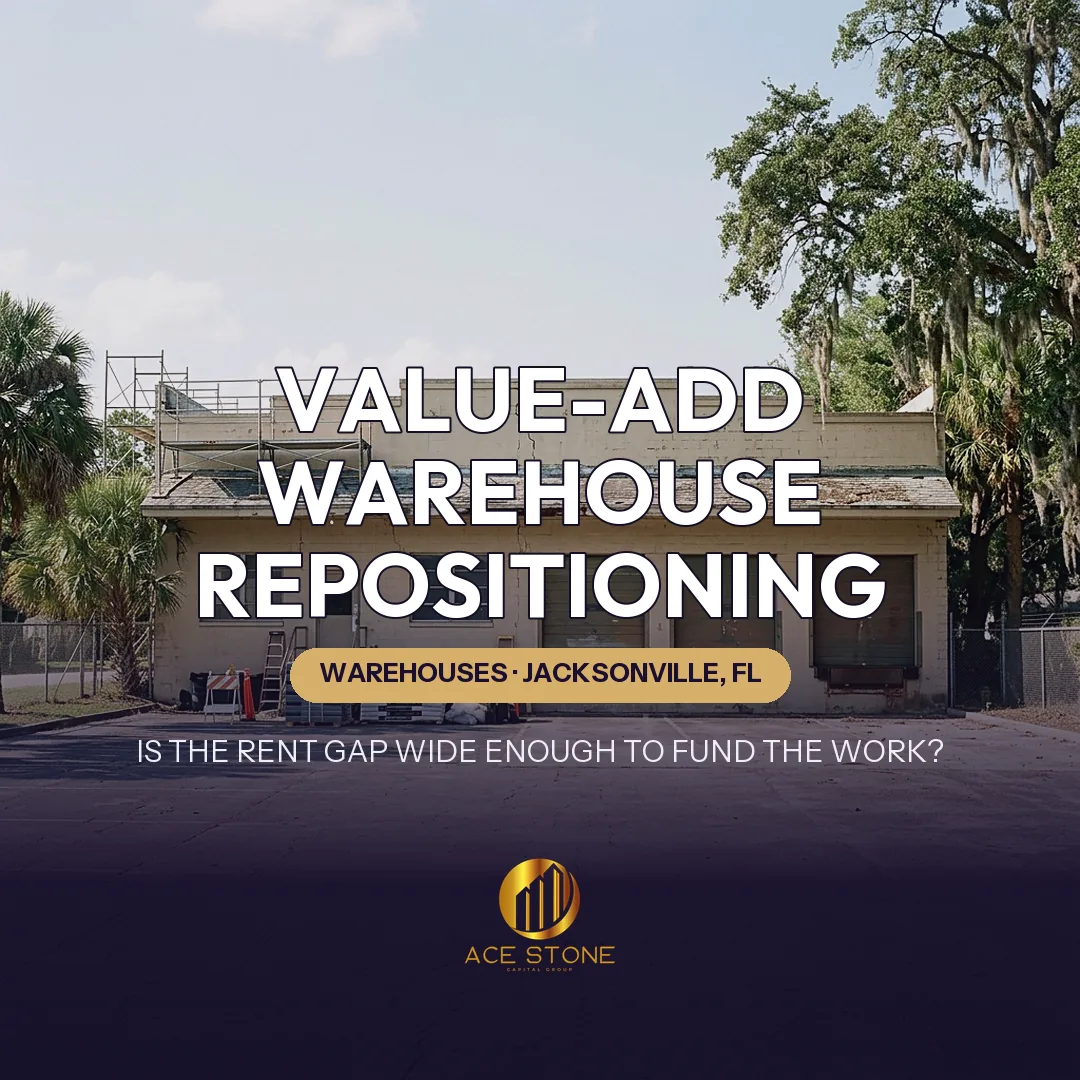
    Older Jacksonville industrial warehouse mid-renovation.
    Representative imagery of the asset type and market — not a photograph of the subject property.

    Case Context

    This acquisition profile examines AceStone Capital Group's underwriting method for an asset of this type. Specific properties, counterparties, and pricing are not identified. The subject profile is an older multi-tenant industrial building in Jacksonville with in-place rents below market, visible deferred maintenance and a lease schedule that rolls over the next several years.

    Executive Summary

    Value-add underwriting has one central question, and it is not whether rents are below market. It is whether the gap between in-place and achievable rent, captured over a realistic timeline and net of the capital and downtime required to capture it, produces a stabilized yield on total cost sufficiently above the stabilized market capitalization rate to compensate for execution risk. A wide rent gap with a wide capital requirement can be worth less than a modest gap with none.

    Applied exampleSee how this played out in Retail Land in Secondary Markets: A Quiet Recovery Story — a commercial acquisition in U.S. Growth Markets.

    Existing Rent Roll

    The rent roll is examined lease by lease rather than in aggregate. For each tenant the analysis records current rent, escalations, remaining term, renewal options and their pricing mechanism, recovery structure, security deposit, and payment history. Leases signed years ago at then-market rates with modest escalators are the source of the gap; leases with below-market fixed renewal options are the reason part of the gap may not be capturable on the timeline the model assumes.

    Quantifying the Market Rent Gap

    Achievable rent is established for the building as it would exist after renovation, not as it stands today — and then a separate as-is achievable rent is established for comparison. The difference between the two is the portion of the uplift attributable to capital rather than to simply resetting expired leases. Distinguishing these is essential: capital that merely reprices a lease that would have repriced anyway is not value creation.

    Applied exampleSee how this played out in Mixed-Use Development Sites in Live-Work Corridors — a commercial acquisition in U.S. Growth Markets.

    Physical Condition Assessment

    The building is surveyed system by system: roof age, membrane type and remaining life with leak history; loading configuration including dock count, leveller condition, seals and shelters, and whether additional dock positions can be cut into the wall economically; warehouse lighting and the case for an LED retrofit; parking and truck court paving condition and drainage; office HVAC, finishes and layout; fire protection design and adequacy for likely commodity classes; electrical service capacity; and exterior condition including paint, signage, fencing and landscaping.

    Renovation Programme and CapEx

    The programme separates three categories of spend. Necessary capital — roof, pavement, code items — must be funded regardless of strategy and generates no rent uplift; it belongs in basis, not in the value-add narrative. Rent-generating capital — dock upgrades, lighting, office modernization, clear-height-neutral layout improvements — is tied to a specific rent assumption. Cosmetic capital — paint, signage, landscaping — is inexpensive and disproportionately affects leasing velocity. Each is estimated with contingency and a schedule.

    Applied exampleSee how this played out in The Value of Entitled Commercial Land in Tight Credit Cycles — a commercial acquisition in U.S. Growth Markets.

    Tenant Retention and Disruption Risk

    Renovating an occupied building creates friction. Roof work, pavement replacement and dock modifications interrupt operations, and tenants under existing leases have no obligation to tolerate disruption without concession. The analysis identifies which tenants are likely to renew at market, which will leave regardless, and which will use the disruption as leverage. Phasing the work around the rollover schedule is usually cheaper than compensating tenants for working around it.

    Scenario One — As-Is Operation

    The first scenario assumes no repositioning: leases roll to as-is market rent, necessary capital is funded as it comes due, and the asset is held as a stabilized older building. This produces a modest, low-risk return and — critically — establishes the baseline against which the renovation case must be judged. A repositioning that beats the as-is case by a thin margin is not worth its execution risk.

    Scenario Two — Renovation and Lease-Up

    The second scenario executes the full programme over a defined period. Capital is deployed on a schedule, units are turned as leases expire, downtime is modelled per unit with realistic marketing periods, and each new lease carries improvement allowance, commissions and free rent. Net operating income declines before it rises, and the model shows that trough explicitly rather than jumping to the stabilized year, because the trough determines the capital the plan actually requires.

    Scenario Three — Stabilized Operation

    The third scenario is the stabilized year following completion: full occupancy at renovated market rents, normalized expenses with taxes reassessed at the purchase basis, and an ongoing reserve appropriate to the improved building. Stabilized net operating income is divided by total cost — purchase price plus all capital plus leasing costs plus carry through the trough — to produce yield on cost. That figure, compared to the capitalization rate a stabilized building of this quality would trade at, is the entire investment case.

    Sensitivity Analysis

    The yield-on-cost calculation is flexed across the variables that actually move it: achievable rent, capital cost overrun, lease-up duration and exit capitalization rate. Renovation budgets are notoriously optimistic in older buildings where opening a roof or a wall reveals conditions no survey captured, so the capital variable is flexed asymmetrically — more upside on cost than downside. Where a fifteen-percent overrun and a six-month delay together eliminate the spread over market capitalization rate, the margin of safety was never there.

    Risk Analysis

    The principal risks are budget overrun in an older structure, tenant attrition exceeding the model, a leasing market that softens during the execution window, and the possibility that achievable post-renovation rent is set by comparables in better-located buildings the subject cannot match. The mitigants are staged capital deployment, phasing tied to actual leasing, contingency funded rather than assumed, and a decision point after the first phase at which the programme can be curtailed.

    Acquisition Decision

    On these underwriting assumptions the transaction warrants acquisition only where the spread between stabilized yield on cost and the stabilized market capitalization rate is wide enough to survive an overrun and a delay simultaneously, and where the purchase price credits the buyer for the necessary capital the seller deferred. If the seller prices the building as though the renovation is already complete, the buyer is funding the work and paying for the result.

    Key Takeaways

    Separate capital that must be spent from capital that earns rent. Compare the repositioning case against a disciplined as-is baseline, not against zero. Model the net operating income trough, not just the stabilized year. And require the yield-on-cost spread to survive a simultaneous overrun and delay, because in older buildings those two arrive together.

    What This Case Shows

    A structured example of how AceStone Capital Group sources, underwrites, and structures off-market commercial acquisitions in Jacksonville, FL. For broader context, see our active acquisition markets or initiate a direct-sale review for a similar property.

    Have a Property to Sell?

    Receive a written offer or a clear pass within 1–2 business days.

    Request a Cash Offer