
Back
    Commercial Jacksonville, FL August 2026

    Distressed Mixed-Use Acquisition: Separating Property Problems From Location Value in Jacksonville

    A Jacksonville corridor building with deferred maintenance and weak management — distinguishing fixable operating distress from permanent real-estate impairment.

    This acquisition profile examines asset strategy, underwriting method, transaction structure, and value-creation considerations. Counterparty and pricing details are not disclosed.

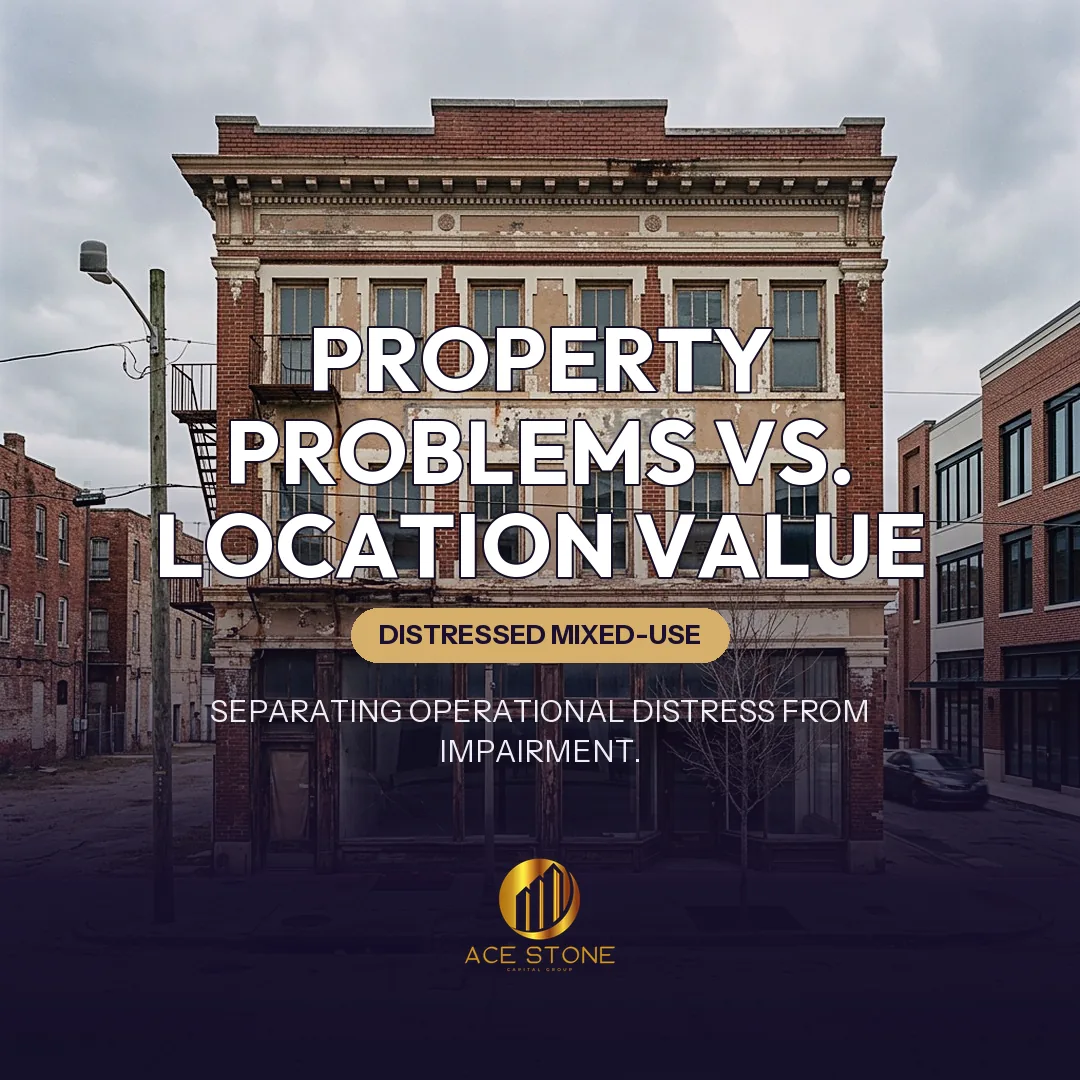
    Older Jacksonville mixed-use building on a transitioning commercial corridor.
    Representative imagery of the asset type and market — not a photograph of the subject property.

    Case Context

    This acquisition profile is educational and modelled; it does not document a AceStone acquisition, an identified property, seller, tenant or price. The subject profile is an older but architecturally substantial mixed-use building on a Jacksonville commercial corridor that is measurably improving around it. The building itself is not improving: maintenance has been deferred for years, tenancy has churned, collections are inconsistent and management has been effectively absent. The entire analysis turns on one distinction — whether the distress belongs to the operation or to the real estate.

    The Central Distinction

    Operational distress is curable with capital, competence and time: deferred repairs, mismanaged collections, below-market leases signed carelessly, poor tenant selection, no preventive maintenance, no marketing. Real-estate impairment is not curable at any price the buyer would accept: a corridor in structural decline, a location without demand drivers, functional obsolescence that cannot be designed around, environmental liability, or a physical structure whose remediation cost exceeds its finished value. Buyers routinely pay distressed prices for the first category and are rewarded, and pay the same prices for the second and are not. Every diligence item in this case is sorted into one bucket or the other.

    Applied exampleSee how this played out in Retail Land in Secondary Markets: A Quiet Recovery Story — a commercial acquisition in U.S. Growth Markets.

    Physical Condition Assessment

    Diligence inventories the roof and its remaining life, structural elements including any masonry cracking or lintel deterioration, foundation and slab condition, envelope and window seals, plumbing supply and waste lines, electrical service and panel capacity, HVAC equipment age across both uses, fire separation and life-safety systems, accessibility compliance, and evidence of past water intrusion or pest activity. Each item receives a scoped cost and a priority tier: immediate safety and habitability, near-term revenue-enabling, and deferrable. The total is not a haircut applied by feel; it is a schedule that flows through the model as timed capital expenditure.

    Tenancy and Collections

    Rent roll review distinguishes contract rent from collected rent. Delinquency history, partial payments, informal arrangements and undocumented concessions are identified, along with leases lacking proper documentation, missing security deposits and expired terms operating on holdover. On the commercial side, uses are assessed for whether they belong in a corridor that is improving — a tenant paying below-market rent while degrading the building's appeal is a negative asset even when current on rent. The realistic stabilized rent roll assumes turnover of the weakest tenancies, with the associated downtime and re-tenanting cost priced in.

    Applied exampleSee how this played out in Mixed-Use Development Sites in Live-Work Corridors — a commercial acquisition in U.S. Growth Markets.

    Operating Inefficiencies

    Weak management shows up in identifiable, fixable line items: utilities running through unmetered or unbilled space, insurance placed without accurate replacement cost or wind-mitigation credits, taxes never appealed after assessment increases, emergency repair spending at premium rates because nothing is maintained on schedule, and vendor arrangements without competitive pricing. Each is quantified as a specific annual dollar improvement with an implementation cost and timeline. This is where the credible part of the value creation lives, and it is credible precisely because it does not depend on market rent growth.

    Location Quality Test

    The corridor is assessed independently of the building: population and household income trends in the surrounding radius, traffic counts, retail occupancy and the quality of new tenancy on nearby blocks, recent private investment and public infrastructure commitments, crime trends, and the direction of nearby residential values. If comparable buildings within a few blocks are leasing to credible operators at healthy rents while the subject cannot, the deficiency is the building or its management. If nothing on the corridor is leasing, the deficiency is the location and no repair budget solves it.

    Applied exampleSee how this played out in The Value of Entitled Commercial Land in Tight Credit Cycles — a commercial acquisition in U.S. Growth Markets.

    Stabilization Budget and Normalized NOI

    The stabilization budget combines the prioritized capital plan, unit and suite turn costs, tenant improvement and commission reserves for commercial re-tenanting, and carrying costs across the stabilization period during which income is suppressed. Normalized net operating income is then constructed from realistic post-stabilization rents, market-rate management, restated taxes and insurance, and a full reserve for replacements. The gap between today's collected income and that normalized figure is the value creation, and its cost and duration are explicit rather than assumed.

    Acquisition Basis and Exit Sensitivity

    The basis is stabilized value less the full stabilization budget, less carrying cost, less a return premium commensurate with execution risk in a building with unknowns behind its finishes. Exit sensitivity is run across a range of capitalization rates rather than a single assumption, because value-add positions are disproportionately exposed to exit-rate movement: a modest widening of the exit rate can erase the entire operating improvement. If the position only clears at an exit rate tighter than entry, it is a bet on the market rather than on the work.

    Reasons to Proceed or Walk Away

    Proceed when the corridor demonstrates independent momentum, when the physical issues are quantified and finite, when comparable nearby buildings achieve the assumed rents today, and when the position survives a conservative exit rate. Walk away when structural or environmental cost is open-ended, when the corridor shows no independent demand, when the stabilization timeline exceeds the capital's patience, or when the seller prices the building as if the work were already complete. The discipline is not finding reasons to transact; it is being genuinely willing not to.

    What This Case Shows

    A structured example of how AceStone Capital Group sources, underwrites, and structures off-market commercial acquisitions in Jacksonville, FL. For broader context, see our active acquisition markets or initiate a direct-sale review for a similar property.

    Have a Property to Sell?

    Receive a written offer or a clear pass within 1–2 business days.

    Request a Cash Offer