Three-Building Mixed-Use Portfolio: Consolidating a Downtown Block in North Carolina
A coordinated acquisition of three adjacent downtown mixed-use buildings — why contiguous control is worth more than the sum of three separate closings.
This acquisition profile examines asset strategy, underwriting method, transaction structure, and value-creation considerations. Counterparty and pricing details are not disclosed.
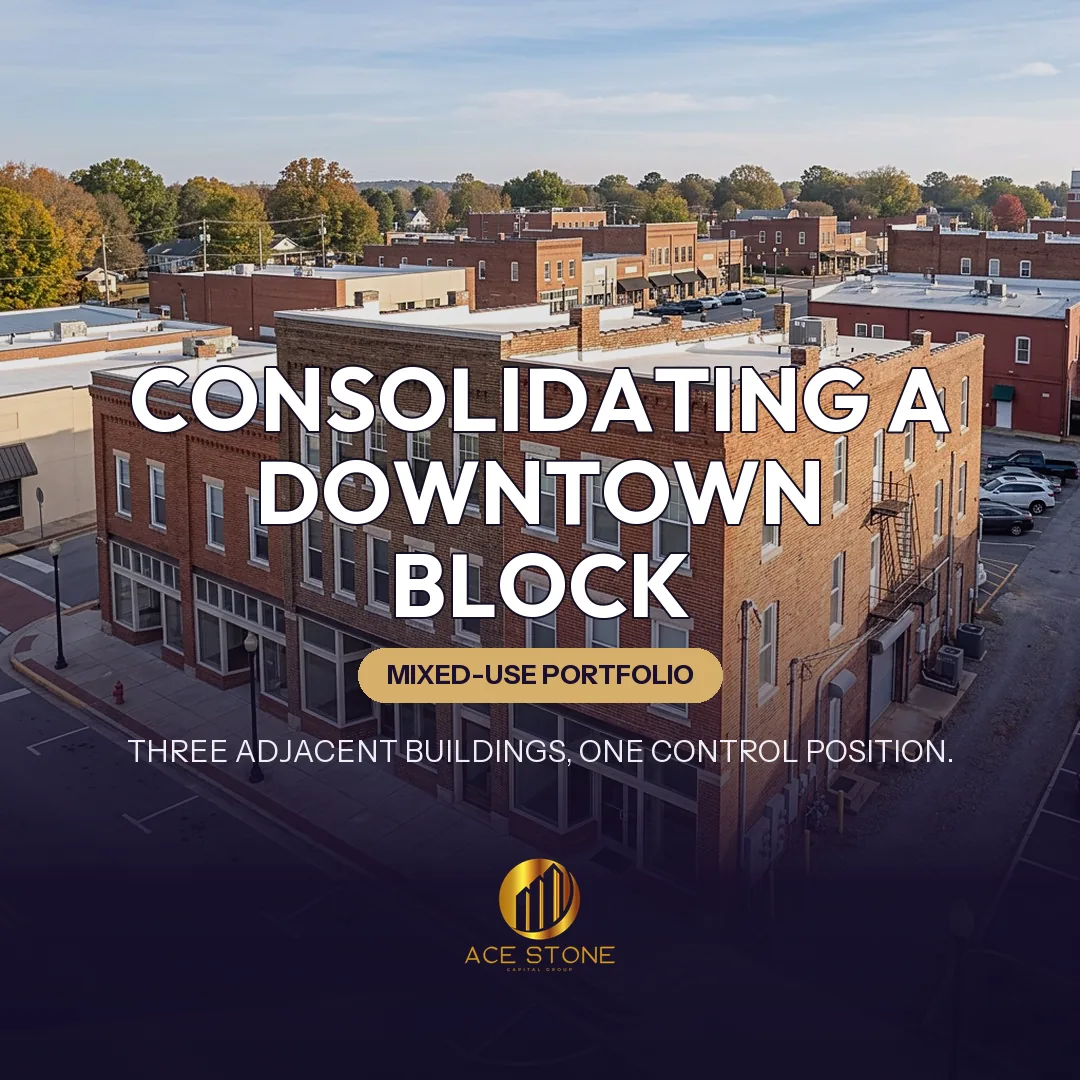
Representative imagery of the asset type and market — not a photograph of the subject property.
Case Context
This is a modelled acquisition analysis prepared as an underwriting study; it does not describe a AceStone acquisition, identified owners, addresses or prices. The subject profile is three adjacent buildings occupying most of one side of a downtown North Carolina block — storefronts at grade with upper-floor residential units above, each in separate ownership with a different holding history, condition and rent position. The strategic premise is that contiguous control changes what the real estate can become, and the analytical discipline is proving that premise numerically rather than asserting it.
Three Owners, Three Situations
Assemblage is a negotiation problem before it is a valuation problem. One owner may be a long-term holder with a low basis and no urgency, another an estate seeking a clean exit, a third an investor whose expectations are anchored to a listing price. Each requires separate diligence, separate documentation and separate terms, yet the strategy only works if all three close. The structure therefore uses cross-conditioned contracts with a common closing date, coordinated diligence periods, and confidentiality — because the moment a block-consolidation strategy is visible, the remaining seller's price expectation adjusts accordingly.
Each building is first valued standalone on its own income, condition and lease profile — the price a buyer of that single asset would rationally pay. The three standalone values are then summed to establish the floor. The combined valuation is developed separately: operating efficiencies from shared management and vendor scale, the ability to renovate and re-tenant in sequence rather than all at once, a coherent retail merchandising plan across a contiguous frontage, and the redevelopment optionality a full block face creates. Assemblage premium is the difference, and paying the entire premium to the sellers eliminates the reason to assemble.
Leases, Units and Rent Position
Every commercial lease across the three buildings is abstracted for term, rent, escalations, recovery structure, options, exclusives and assignment rights — exclusives matter unusually here, since an exclusive-use clause in one building constrains merchandising in the others once common ownership exists. Residential units are reviewed for lease status, rent against submarket comparables, condition and turnover history. The consolidated rent roll reveals rollover concentration across the block, which is both a risk to manage and the mechanism through which a coherent tenant mix eventually gets built.
Adjacent older buildings are rarely cleanly separated. Diligence examines party walls and their structural role, whether utility services cross property lines, meter locations and how consumption is currently allocated, shared or encroaching rear access, roof drainage that discharges across a neighboring parcel, and any prior informal arrangements never documented in easements. Under separate ownership these are latent disputes; under common ownership they become manageable engineering items — and, where a future combination is contemplated, they must be documented properly so that any subsequent single-building sale does not create the very disputes consolidation resolved.
Renovation Sequencing
Owning three buildings permits sequencing that a single-asset owner cannot achieve. Work proceeds building by building so income continues from the other two, tenants can be relocated within the block during construction rather than lost, contractor mobilization is amortized across a larger scope, and materials and finishes can be standardized. The capital plan is therefore phased with defined milestones and a decision gate between phases, allowing the program to stop after phase one if leasing outcomes disappoint. That optionality is itself part of the portfolio's value.
Contiguous frontage creates possibilities unavailable to any single building: a larger floor plate for a tenant that could not otherwise locate downtown, a unified facade and streetscape program, shared service and loading, and — subject to zoning, historic review and market conditions — the eventual possibility of a larger redevelopment across combined parcels. None of that optionality is assumed as value in the underwriting. It is documented, preserved through careful title and easement work, and left as upside. The base case must clear on the operating income of three renovated mixed-use buildings.
Portfolio NOI, Basis and Exit
Portfolio net operating income consolidates all three rent rolls against a single expense model reflecting shared management, insurance placed as one program, and combined reserves. The acquisition basis is the aggregate of standalone values plus only the portion of assemblage premium required to secure agreement, less the phased capital plan, less carrying cost during renovation. Exit alternatives are deliberately plural: sell the portfolio intact to a regional owner, sell buildings individually into a stronger downtown market at retail pricing, or hold and eventually contribute the assembled parcels into a redevelopment. Multiple exits with different buyer pools is the strongest argument for the strategy.
Key Takeaways
Assemblage rewards patience and penalizes visibility. The premium belongs to whoever solves the coordination problem, so it must not be pre-paid to sellers. Cross-conditioned closings protect against the partial-assemblage outcome, which is the worst result available — full price, none of the strategic benefit. And the base case must survive on operating fundamentals alone, because redevelopment optionality on a downtown block is measured in years and approvals, not quarters.
What This Case Shows
A structured example of how AceStone Capital Group sources, underwrites, and structures off-market commercial acquisitions in North Carolina. For broader context, see our active acquisition markets or initiate a direct-sale review for a similar property.
Have a Property to Sell?
Receive a written offer or a clear pass within 1–2 business days.