
Back
    Commercial Austin, TX August 2026

    From Aging Strip Center to Mixed-Use Development Site: Austin Growth Corridor

    A Austin retail center where land value may exceed improved value — separating the price of current income from the price of future optionality.

    This acquisition profile examines asset strategy, underwriting method, transaction structure, and value-creation considerations. Counterparty and pricing details are not disclosed.

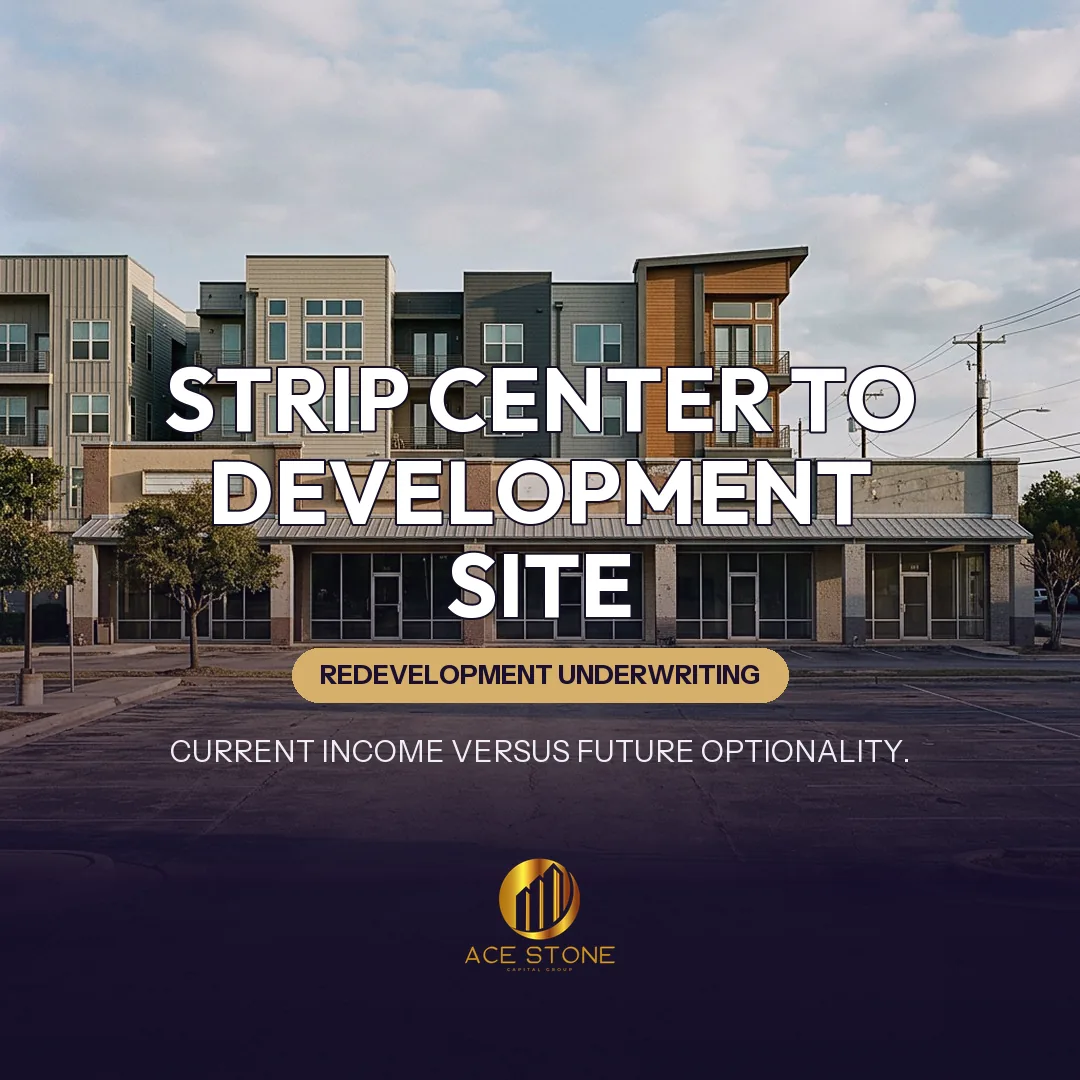
    Aging Austin strip retail center in front of newer high-density mixed-use development.
    Representative imagery of the asset type and market — not a photograph of the subject property.

    Case Context

    This modelled analysis is educational and does not document a AceStone acquisition, a specific site, owner, tenant or price. The subject profile is an aging single-story retail center on a high-growth Austin corridor: modest improvements on a comparatively large, well-located parcel, surrounded by newer higher-density development. The asset generates income today. The underlying land may be worth more than the improvements standing on it. The analysis exists to determine which of those two facts should set the purchase price — and what the buyer is actually paying for.

    Existing Retail Income

    The in-place income is characterized honestly: tenant mix, credit quality, lease terms and expirations, rent levels relative to corridor market, recovery structure, and vacancy history. An older center in a strong location often carries below-market rents on long-dated leases, or conversely a series of short-term and month-to-month tenancies that produce flexibility for a future redeveloper. Which pattern applies changes the strategy materially: long leases with no termination rights can delay redevelopment for years or require expensive buyouts, and every one of those buyouts is an assumed cost, not a footnote.

    Applied exampleSee how this played out in Mixed-Use Development Sites in Live-Work Corridors — a commercial acquisition in U.S. Growth Markets.

    Holding Income and Carry

    During any entitlement and planning period, the existing center produces income that offsets carrying cost. That income is modeled with declining occupancy as leases roll and are replaced only on short-term or terminable structures, and net of taxes, insurance, management and the maintenance an aging center genuinely requires. The result is a realistic carry profile rather than the assumption that current net income persists unchanged until the day demolition begins. Positive carry lengthens the patience the position can afford; negative carry imposes a schedule the entitlement process may not respect.

    Land, Zoning and Density Analysis

    The redevelopment case is built from the site's physical and regulatory capacity: net usable land area after right-of-way dedication, easements and drainage or detention requirements; the base zoning district and its permitted uses; floor-area ratio and height limits; setbacks and compatibility standards relative to adjacent uses; parking requirements and whether reductions are available; and any corridor plan, overlay or affordability-linked density program that applies. Where the desired program exceeds what is permitted by right, the path, timeline, cost and uncertainty of a rezoning or variance are stated explicitly — and never assumed to succeed.

    Applied exampleSee how this played out in The Value of Entitled Commercial Land in Tight Credit Cycles — a commercial acquisition in U.S. Growth Markets.

    Redevelopment Program and Costs

    A conceptual program is tested for physical fit: ground-floor retail with residential above, the parking solution that program requires, and the resulting unit count and leasable retail area. Cost estimation covers tenant buyouts, demolition and disposal, environmental screening and any remediation, site work including utilities, detention and grade, structured or surface parking, vertical construction at current Austin cost levels, soft costs, impact and permit fees, financing costs across the construction period, and contingency. Timeline is modeled from entitlement through design, permitting, construction and lease-up — typically several years, during which cost and rent assumptions both move.

    Residual Land Value

    Residual land value is the disciplined answer: take the completed project's stabilized value, subtract total development cost, subtract the developer profit margin required for the risk taken, and what remains is the maximum supportable land price. That figure is compared against the value of the property as an income-producing retail center. If residual land value materially exceeds income value, the redevelopment thesis has substance. If the two are close, the buyer is paying for optionality that may never be exercised, and the income case must justify the price on its own.

    Applied exampleSee how this played out in Data Centers & Energy-Corridor Land Opportunities — a commercial acquisition in U.S. Growth Markets.

    Acquisition Basis and Sensitivity

    The basis is set at or near income value, with redevelopment treated as upside rather than as the justification for the price. Sensitivity analysis runs the residual calculation across ranges for construction cost, achievable residential rents, retail rents, exit capitalization rate, entitlement duration and interest cost. Residual land value is extraordinarily sensitive to each of these; a ten percent construction cost increase combined with modest exit-rate widening can eliminate the residual entirely. Presenting a single-point residual as the land value is the most common error in redevelopment underwriting.

    What Would Invalidate the Thesis

    The thesis fails if the required density is not approved or is approved with conditions that erode feasibility; if construction cost escalation outpaces rent growth; if corridor apartment supply overwhelms absorption during the delivery window; if capital costs rise enough to widen exit rates; if a long-dated tenant cannot be bought out at a rational price; or if environmental or infrastructure conditions impose unbudgeted cost. Each is defined in advance with an observable trigger, so the decision to abandon redevelopment and operate the center is made on evidence rather than sentiment.

    Key Takeaways

    Buying current income and buying future optionality are different transactions with different risk profiles, and confusing them is expensive. The disciplined structure pays for income, preserves optionality, keeps lease structures short and terminable, and treats entitlement as a milestone rather than an assumption. A site that only works if everything goes right is not an opportunity; it is a position waiting for one variable to move.

    What This Case Shows

    A structured example of how AceStone Capital Group sources, underwrites, and structures off-market commercial acquisitions in Austin, TX. For broader context, see our active acquisition markets or initiate a direct-sale review for a similar property.

    Have a Property to Sell?

    Receive a written offer or a clear pass within 1–2 business days.

    Request a Cash Offer