
Back
    Commercial Austin, TX August 2026

    Single-Tenant Office Acquisition: Pricing Lease Expiration Risk in Austin

    A Austin office building fully occupied by one corporate tenant — and why 100% occupancy can be the most concentrated risk in the market.

    This acquisition profile examines asset strategy, underwriting method, transaction structure, and value-creation considerations. Counterparty and pricing details are not disclosed.

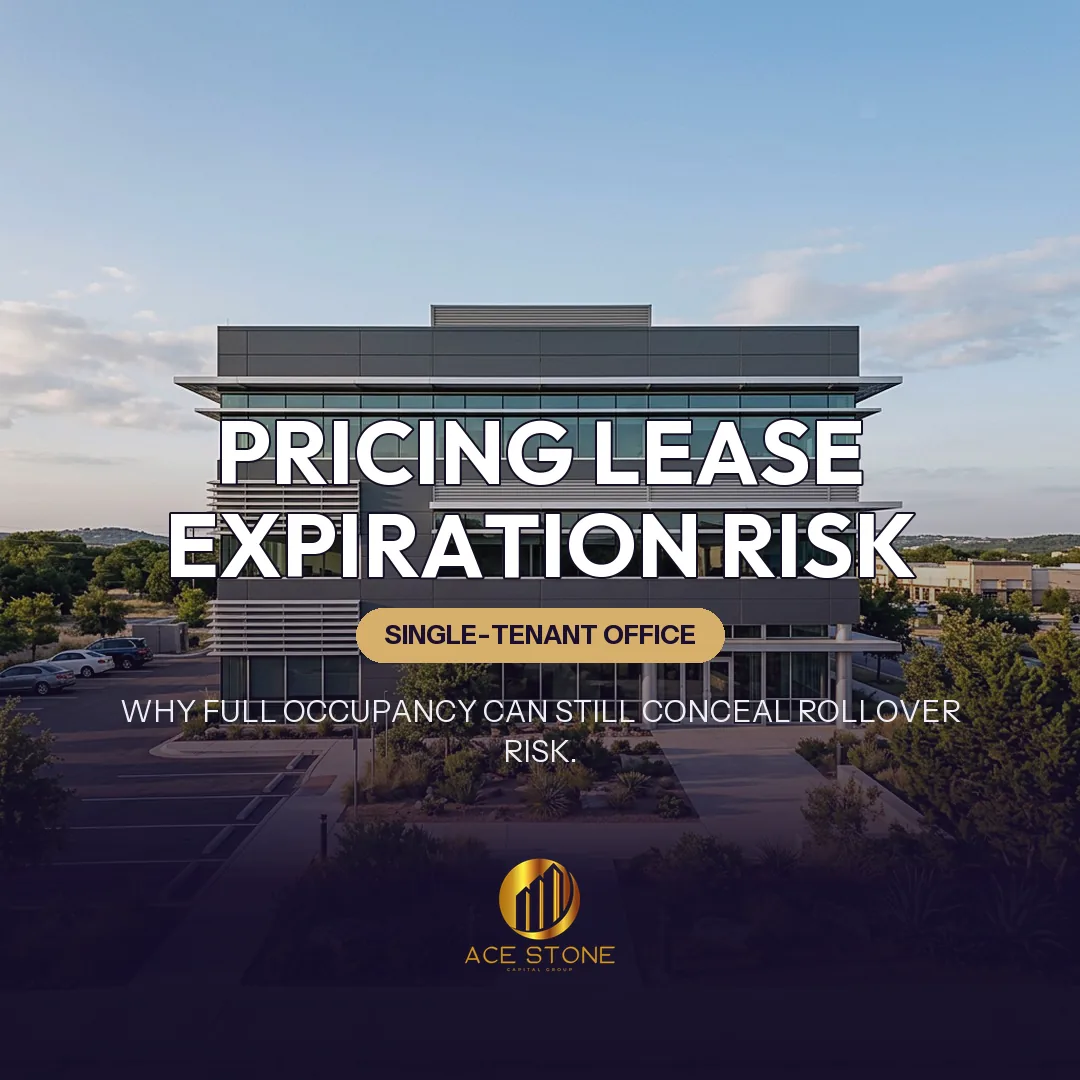
    Austin single-tenant corporate office building.
    Representative imagery of the asset type and market — not a photograph of the subject property.

    Case Context

    This acquisition profile examines AceStone Capital Group's underwriting method. Specific properties, counterparties, and pricing are not identified. The subject profile is a modern low-rise Austin office building occupied in its entirety by a single corporate user, with a lease that expires within the intended hold period. Fully leased assets screen well: no vacancy, no leasing budget, clean cash flow. The underwriting reality is that the building has one income event, and everything depends on what that tenant does at expiration.

    Reading the Lease Before the Rent Roll

    The lease document is the asset. Abstraction records base rent and the full escalation schedule, expense structure and any caps or gross-up mechanics, remaining term and renewal options with their notice windows and rent-setting mechanism, early-termination rights and their fees, expansion and contraction rights, assignment and sublease provisions, restoration and surrender obligations, landlord maintenance and capital responsibilities, and any unamortized improvement or free-rent balance. A renewal option struck at a fixed below-market rate, or a termination right exercisable mid-term, changes value more than a hundred basis points of capitalization rate.

    Applied exampleSee how this played out in Mixed-Use Development Sites in Live-Work Corridors — a commercial acquisition in U.S. Growth Markets.

    Tenant Credit and Business Fit

    Credit analysis covers the entity actually on the lease — parent, subsidiary or guarantor — and its financial capacity, not the brand on the building. Beyond credit, the review asks whether the space still fits the business: headcount trend, hybrid-work policy, whether the building houses a headquarters function or a replaceable satellite office, how much of committed capital the tenant has invested in the improvements, and whether the location is operationally important. A financially strong tenant with excess space is a renewal risk; a modest-credit tenant with a purpose-built facility and local workforce ties may be far stickier.

    Rent Position and Escalations

    Contract rent is compared with current effective market rent for equivalent Austin product, net of concessions. Where the in-place rate sits above market, the going-in yield is flattered and the renewal conversation will be a reduction, not an increase. Where it sits below market, there is embedded upside — but capturing it requires the tenant either to renew at market or to leave, and the second path costs downtime and capital. Contractual escalations are modelled as they read; a fixed annual bump is worth a different amount than an index-linked adjustment with a cap.

    Applied exampleSee how this played out in The Value of Entitled Commercial Land in Tight Credit Cycles — a commercial acquisition in U.S. Growth Markets.

    Three Rollover Scenarios

    Scenario one, renewal: the tenant extends at a negotiated rate, the landlord funds a refresh allowance and pays a renewal commission, there is no downtime, and income continues with a reset basis. Scenario two, departure: the tenant vacates at expiration, the building goes fully dark, and the owner funds carrying costs, a full second-generation improvement allowance, marketing, free rent and full commissions across an absorption period measured in quarters or years. Scenario three, renegotiation: the tenant stays but resets economics downward, gives back a floor, or trades term for concessions. Each scenario is modelled with its own cash-flow profile and its own exit value.

    Alternative-User Analysis

    Because scenario two is the one that determines the floor, the building is tested for re-tenantability before the price is set. That means asking whether the space can be demised into multiple suites without structural work, whether there is a common corridor and shared restroom configuration or only tenant-exclusive circulation, whether the lobby and elevator core support multi-tenant use, whether parking supports a denser occupancy, and how specialized the existing improvements are. Purpose-built features — a large data room, a specialized lab, a fitness centre, an auditorium — are counted as demolition cost rather than as amenity value.

    Applied exampleSee how this played out in Data Centers & Energy-Corridor Land Opportunities — a commercial acquisition in U.S. Growth Markets.

    Downtime, Capital and the Vacancy Path

    The departure case is budgeted line by line: months of full carry with no offsetting income, taxes and insurance unabated, base building capital that a multi-tenant conversion requires, demising walls and corridor construction, improvement allowances for two or three replacement tenants, free rent, and commissions on each new lease. Absorption is drawn from actual submarket data for comparable size and quality, not from an average that includes trophy product. The cumulative cash requirement of this path is often larger than a year of the building's net operating income, and it is funded by the buyer.

    Pricing Logic and Capitalization

    A single-tenant asset with short remaining term should not be capitalized like a stabilized multi-tenant building. The defensible approach values the contracted income stream over its remaining term and separately values the residual — what the building is worth as vacant or partially leased real estate after the lease burns off — then discounts both. That method makes the concentration visible: if most of the value depends on renewal, the price is a bet on one counterparty's real-estate decision. Pricing to the residual, with renewal treated as upside, produces a basis that survives scenario two.

    Exit Considerations

    Buyer depth for single-tenant office varies with remaining term. Long-dated, credit-backed leases attract net-lease capital; short-dated leases attract value-add buyers who price to vacancy. If the hold plan involves selling before expiration, the exit market will be applying the same rollover analysis with less runway, which usually means a wider capitalization rate than at entry. The model reflects that rather than assuming rate compression.

    Key Takeaways

    Occupancy is not the same as safety. A fully leased single-tenant building concentrates binary risk in one expiration date, and the correct response is to underwrite the residual real estate as if the tenant will leave, then treat renewal as upside rather than as the base case. Read the options, price the demising cost, and buy the building — not the lease. Owners of comparable Austin office assets can review acquisition parameters with the firm's acquisition desk.

    What This Case Shows

    A structured example of how AceStone Capital Group sources, underwrites, and structures off-market commercial acquisitions in Austin, TX. For broader context, see our active acquisition markets or initiate a direct-sale review for a similar property.

    Have a Property to Sell?

    Receive a written offer or a clear pass within 1–2 business days.

    Request a Cash Offer