
Back
    Commercial Dallas, TX August 2026

    Neighborhood Mixed-Use Acquisition: Essential Retail With Residential Density in Dallas

    A Dallas asset pairing neighborhood-serving retail with apartments above — where the two uses reinforce each other, and where they collide.

    This acquisition profile examines asset strategy, underwriting method, transaction structure, and value-creation considerations. Counterparty and pricing details are not disclosed.

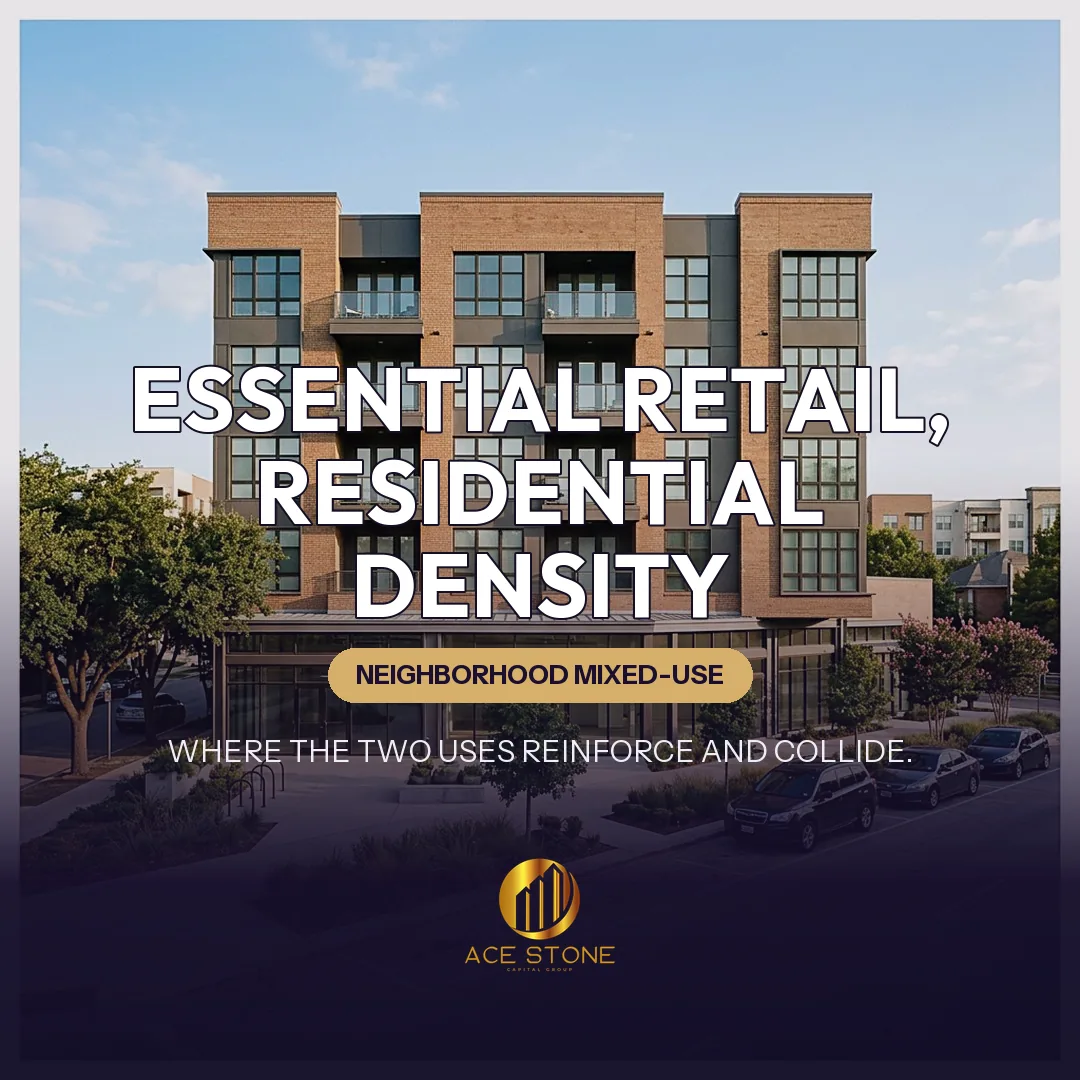
    Modern Dallas neighborhood mixed-use development with ground-floor retail and apartments above.
    Representative imagery of the asset type and market — not a photograph of the subject property.

    Case Context

    This acquisition profile examines AceStone Capital Group's underwriting method. Specific properties, counterparties, and pricing are not identified. The subject profile is a purpose-built Dallas neighborhood development: ground-floor retail serving daily needs with multiple residential floors above. Unlike an older converted building, this asset was designed for dual use, which removes many physical problems and introduces different ones — shared systems, allocated expenses, contested parking and a tenant mix whose performance depends partly on the residents living upstairs.

    Retail Tenant Mix and Credit

    Tenant analysis examines what each retail tenant actually sells and to whom. Daily-needs uses — food and beverage, personal services, fitness, convenience, medical adjacent — draw recurring trips from the immediate trade area and are comparatively resilient. Discretionary or destination uses depend on drawing customers from further out, which a neighborhood location may not support. Credit is assessed by category: national or regional operators with financial reporting, franchisees with guarantees, and independent operators whose viability rests on the individual. Each classification carries a different capitalization treatment, because the market prices the durability of the income, not the rent number.

    Applied exampleSee how this played out in Why Industrial Land Is the New Core Asset — a commercial acquisition in U.S. Growth Markets.

    Lease Structure and Rollover

    Lease abstraction records term, base rent and escalations, percentage-rent provisions if any, recovery structure for taxes, insurance and common-area maintenance, renewal options and option rents, exclusive-use rights, co-tenancy conditions, relocation rights and guarantees. Expirations are laid out on a schedule across the projected hold, with the concentration in any single year measured. Where several leases expire together, the model reserves for simultaneous downtime, tenant improvement and commissions rather than assuming staggered, orderly renewals — because renewal probability is an assumption, not a fact, and it is stated explicitly with the reasoning behind it.

    Residential Performance

    The residential component is underwritten on the current rent roll against comparable Dallas product: unit mix and size, in-place rent versus market, concession levels in the competitive set, turnover rate, average tenure, delinquency and current occupancy. Retail below can support residential rent through convenience, or suppress it through noise, odor and late-hour activity depending on the uses in place. That interaction is assessed specifically rather than assumed positive — a late-night venue below apartments is a rent and retention issue, whatever it pays.

    Applied exampleSee how this played out in Retail Land in Secondary Markets: A Quiet Recovery Story — a commercial acquisition in U.S. Growth Markets.

    Expense Allocation Between Uses

    Correct allocation determines whether the reported net income of each component is real. The model examines separate metering for the retail bays, how common-area electricity, water, irrigation and trash are split, how insurance premium is attributed across occupancy classes, how the tax bill is apportioned, how much management time each component consumes, and which repairs belong to which use. Where the recovery language in leases does not match how costs are actually incurred, the shortfall lands on ownership — and that gap is quantified, because a well-drafted recovery clause that nobody has been billing is not income.

    Parking and Shared Areas

    Parking is the most common source of friction in neighborhood mixed-use. Retail demand peaks at midday and evening; residential demand peaks overnight and on weekends, which theoretically permits shared use. In practice, restaurant peaks overlap residential evening demand and residents resent competing for spaces they believe they pay for. Diligence counts total supply, reviews any parking allocation or assignment in the leases, examines enforcement practice, and tests the ratio against both code requirement and observed demand. Shared lobbies, corridors, refuse areas and loading zones are reviewed for adequacy and for who pays to maintain them.

    Applied exampleSee how this played out in Mixed-Use Development Sites in Live-Work Corridors — a commercial acquisition in U.S. Growth Markets.

    NOI, Basis and Stabilized Yield

    Net operating income is built separately for each component using correctly allocated expenses, then consolidated. The retail stream is capitalized against neighborhood-retail comparables reflecting term, credit and tenant concentration; the residential stream against Dallas multifamily comparables adjusted for unit mix and the specifics of living above retail. Acquisition basis is derived from the component sum less deferred capital items, less reserves for scheduled rollover, and less the return premium a hybrid asset requires. Stabilized yield is then tested against the yield available from a single-use asset of comparable quality — if the hybrid does not pay a premium for its additional complexity, the complexity is not worth owning.

    Complementarity and Conflict

    The genuine advantages are real: residents provide a captive customer base that improves retail sales and therefore retail retention; retail amenity supports residential rents and reduces turnover; and two income streams diversify against a downturn concentrated in one sector. The conflicts are equally real: differing operating hours, noise and odor transmission, refuse and loading conflicts, parking competition, and the fact that a single management team must be competent in two disciplines. Underwriting reflects both, and management cost is set at a level that can actually deliver both.

    Exit Buyer Profile and Takeaways

    The exit pool for well-located neighborhood mixed-use is broader than for older hybrid buildings: private and regional investors, family offices seeking diversified income, and occasionally institutional buyers where scale and construction quality permit. Breadth of demand supports the exit rate assumption, but only when the retail leases are long enough and the tenancy credible enough that a buyer is not underwriting immediate rollover. The lesson: in mixed-use, the durability of the retail lease structure, not the headline rent, is what the exit market ultimately capitalizes.

    What This Case Shows

    A structured example of how AceStone Capital Group sources, underwrites, and structures off-market commercial acquisitions in Dallas, TX. For broader context, see our active acquisition markets or initiate a direct-sale review for a similar property.

    Have a Property to Sell?

    Receive a written offer or a clear pass within 1–2 business days.

    Request a Cash Offer