E-Commerce Fulfillment Center: Pricing Automation and Tenant-Specific Improvements in Las Vegas
A automated fulfillment facility in Las Vegas, underwritten by separating durable building infrastructure from tenant-specific equipment with limited residual value.
This acquisition profile examines asset strategy, underwriting method, transaction structure, and value-creation considerations. Counterparty and pricing details are not disclosed.
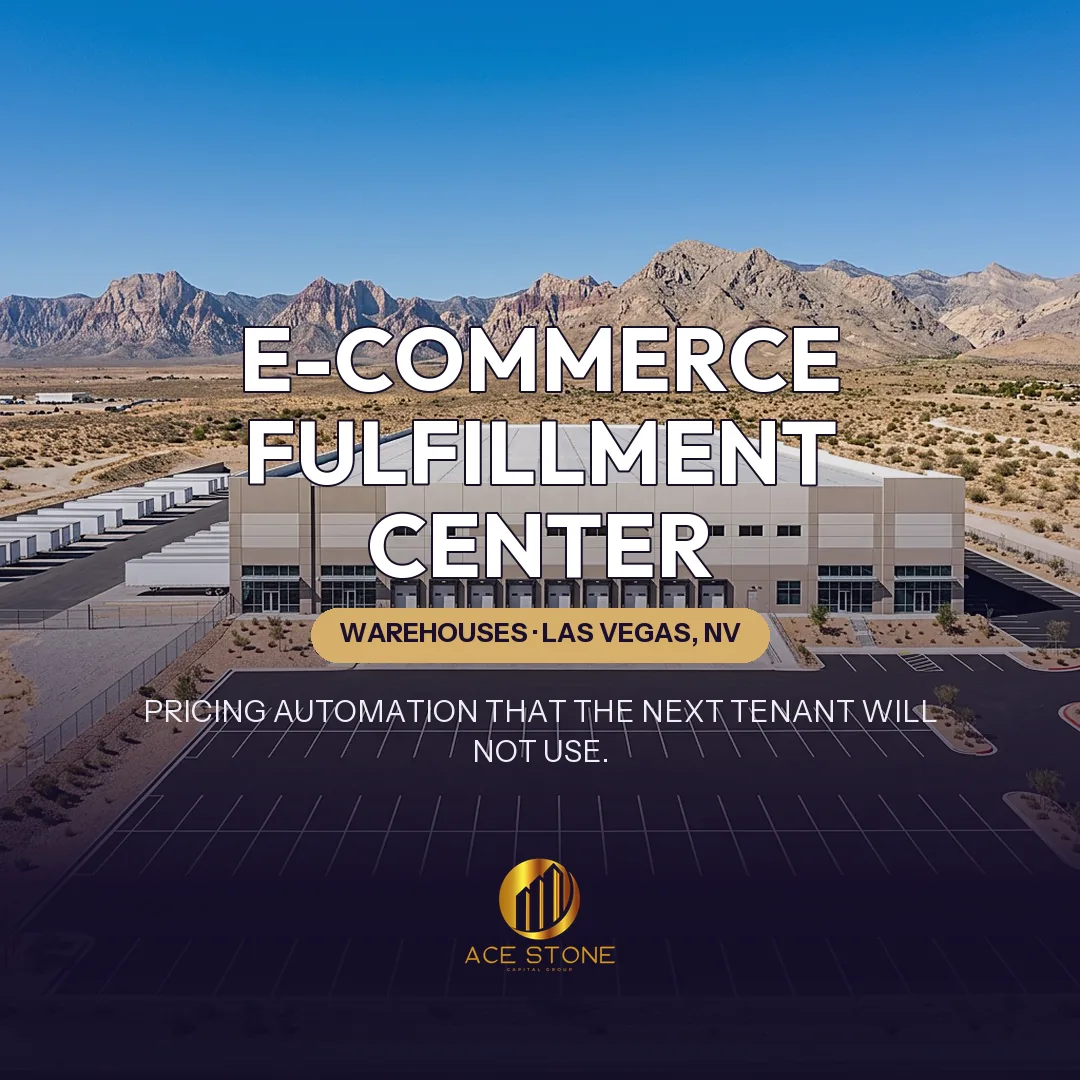
Representative imagery of the asset type and market — not a photograph of the subject property.
Case Context
This acquisition profile examines AceStone Capital Group's underwriting method for an asset of this type. Specific properties, counterparties, and pricing are not identified. The subject profile is a modern fulfillment warehouse in the Las Vegas region occupied by a single e-commerce operator, containing substantial automation and extensive tenant-specific improvements.
Executive Summary
Automated fulfillment facilities present a valuation trap. The rent is high, the tenant appears deeply committed, and the building is full of expensive equipment. But much of that equipment is either owned by the tenant or specific to its operating model, and the rent premium it supports evaporates when the occupier leaves. The analysis separates durable building infrastructure from tenant-specific improvements and values only the former as permanent real estate.
The regional logic is distribution reach into the Southwest and the ability to serve large Western population centres within short transit times, combined with land availability, a labour pool accustomed to shift-based operations and a state tax environment operators find favourable. The analysis measures competing fulfillment inventory, recent large-format deliveries and announced construction, because a market that attracts operators also attracts developers, and abundant new supply constrains re-leasing leverage.
The Improvement Taxonomy
Every improvement is classified into one of three categories, and the classification governs how it is valued. Base building — structure, slab, roof, dock doors and levellers, primary electrical service, fire protection, lighting, yard and parking — is durable and transfers to any occupier. Enhanced building infrastructure — additional electrical distribution, upgraded fire protection for automated storage, reinforced slab areas, HVAC in process zones — is building-owned and transfers with reduced but real value. Tenant-specific systems — conveyors, sortation, robotics, mezzanines built for a particular process, and proprietary software integration — may transfer physically and still deliver almost no value to a different operator.
Legal ownership is established before value is assigned. The lease and any work letter determine which improvements are landlord property and which are tenant trade fixtures removable at expiry. Financing liens on tenant-owned equipment are searched. Removal and restoration obligations are read carefully: a tenant obligated to remove its systems and restore the premises leaves a shell, while a tenant permitted to abandon them leaves the landlord with disposal cost and a layout that may impede the next occupier.
Electrical and Power Requirements
Automated operations draw materially more power than conventional distribution. Incoming service capacity, distribution configuration, transformer capacity, panel and switchgear condition and available headroom are recorded. Enhanced power capacity is one of the few automation-adjacent attributes with genuine residual value, because it broadens the future tenant pool to include other automated or power-intensive users. That is a real building improvement and is credited as such.
The durable specification is scored independently of the current use: clear height, column spacing, dock-high door count and ratio, truck court depth, trailer parking stalls, employee parking count and its adequacy for a shift-based workforce, slab flatness and load capacity, fire protection design, and office ratio. Employee parking is a specific consideration for fulfillment use — labour-intensive operations require far more car parking than a conventional distribution facility, and a shortfall narrows the replacement pool to less labour-intensive users.
Lease Economics and the Rent Premium
Contract rent is decomposed. A portion reflects market rent for the base building; a portion is an amortization of landlord-funded improvements over the lease term; a portion reflects the tenant's willingness to pay for a facility configured to its operation. Only the first portion is durable market rent. The second is a return of capital that ends with the lease, and the third is occupier-specific and does not survive a departure. Capitalizing the total rent at a market capitalization rate treats all three as permanent, which overstates value materially.
Replacement-User Analysis
The analysis counts the plausible replacement occupiers for the building as configured. Another operator with a comparable automated model may value some infrastructure but will almost certainly install its own systems. A conventional distribution tenant will require removal of mezzanines and conveyors to recover floor area and rack height. A lighter-industrial user may be constrained by parking or by the specialized layout. The realistic conclusion in most cases is that the next tenant pays base-building market rent, and the automation contributes little or nothing.
Stress Test — Departure at Expiry
The stress test assumes the occupier does not renew. Income stops. The landlord faces removal or disposal of abandoned systems, demolition of mezzanines and conveyor supports, slab and wall repair, restoration of racking clearance, and re-leasing costs including allowance, commissions and free rent — all while carrying taxes at reassessed value, insurance, utilities and maintenance. The resulting stabilized income is base-building market rent on a building of that vintage, capitalized at a market rate. That figure, less transition cost, is the true downside value and it is frequently far below the price justified by in-place rent.
Scenario and Sensitivity Analysis
Three scenarios are carried: renewal at market with the automation retained; departure with a replacement automated user who values enhanced power and slab work but installs its own systems; and departure with a conventional user requiring full restoration. Each is flexed for base-building market rent, downtime, restoration cost and exit capitalization rate. The spread across scenarios in an automated facility is markedly wider than in a conventional distribution asset, and that dispersion is itself a pricing input.
Acquisition Decision
On these underwriting assumptions the asset is investable where the purchase price is supported by base-building value plus credit for genuinely durable enhancements such as excess power capacity and reinforced slab, where the lease requires removal and restoration at the tenant's cost, and where the contract rent premium is treated as term income rather than as permanent value. Pricing the automation into the capitalized value is the error the analysis exists to prevent.
Key Takeaways
Classify every improvement as base building, enhanced infrastructure or tenant-specific before assigning value. Establish legal ownership and restoration obligations in the lease, not from the site tour. Capitalize only durable market rent, and underwrite the facility as though the next occupier arrives with its own equipment — because it will.
What This Case Shows
A structured example of how AceStone Capital Group sources, underwrites, and structures off-market commercial acquisitions in Las Vegas, NV. For broader context, see our active acquisition markets or initiate a direct-sale review for a similar property.
Have a Property to Sell?
Receive a written offer or a clear pass within 1–2 business days.