Building or Land? Pricing an Obsolete Infill Warehouse in Northern New Jersey
A functionally obsolete warehouse on scarce Northern New Jersey industrial land, tested as three separate investments: hold, renovate, or redevelop.
This acquisition profile examines asset strategy, underwriting method, transaction structure, and value-creation considerations. Counterparty and pricing details are not disclosed.
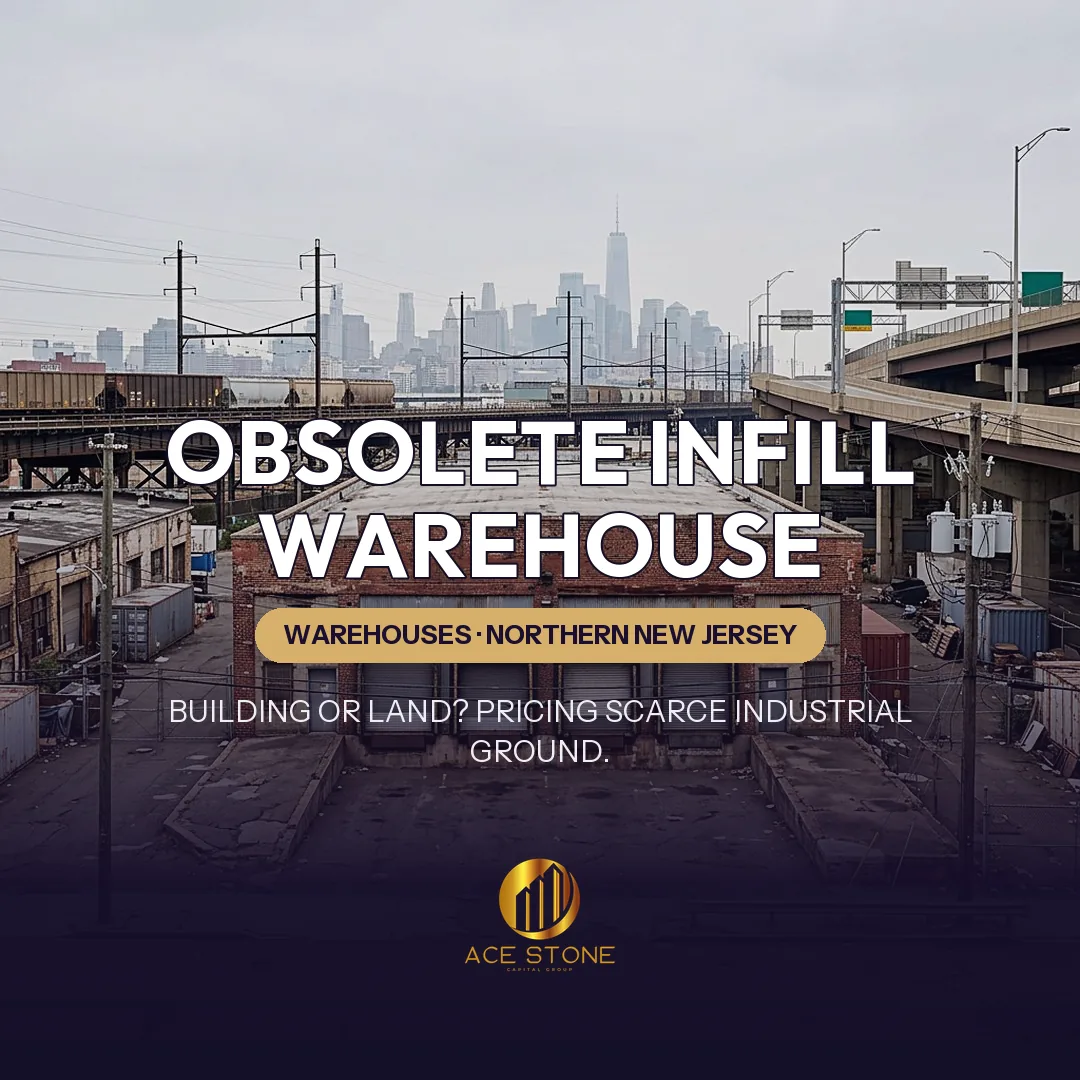
Representative imagery of the asset type and market — not a photograph of the subject property.
Case Context
This acquisition profile examines AceStone Capital Group's underwriting method for an asset of this type. Specific properties, counterparties, and pricing are not identified. The subject profile is an older warehouse on an infill Northern New Jersey industrial site within the transportation network serving the New York metropolitan consumer base.
Executive Summary
Two facts define the asset and they point in opposite directions. The building is functionally obsolete — low clear height, inadequate loading, an inefficient configuration and aging systems. The land is close to irreplaceable, sitting inside a market with severe industrial land scarcity, dense consumer population and high barriers to new supply. The underwriting task is to determine which of the two is the asset, and to price accordingly.
The building's constraints are catalogued precisely because they set the ceiling on the hold case: clear height well below modern specification, which makes cubic volume unusable for racking; a dock count and configuration inadequate for distribution throughput; a truck court too shallow for comfortable tractor-trailer maneuvering; column spacing that constrains racking layout; a slab of uncertain capacity; and roof, electrical and fire protection systems approaching or past their economic lives.
Location Advantages
Against those constraints sits a location profile that cannot be reproduced: proximity to one of the largest consumer concentrations in the country, access to port, rail and highway infrastructure, and an industrial land market where remaining sites are scarce, expensive, frequently encumbered by prior industrial use, and slow to entitle. New supply is limited by land availability and process, not by construction capacity. Rents for modern space in the submarket reflect that scarcity.
The analysis begins by valuing the site as vacant, entitled industrial land at market rates for the submarket, then deducting demolition, abatement, any environmental remediation and site preparation. That residual is the land-basis floor. Where the floor approaches or exceeds the value of the property as an income-producing warehouse, the improvements are contributing little or nothing, and the asset should be underwritten as a land transaction with an interim income stream attached.
Strategy One — Continue Operating
The hold case leases the building as it stands to users for whom the limitations do not bind: storage, contractor operations, light assembly, vehicle or equipment users, and third-party operators seeking cheap covered space near the consumer. Rents are well below modern distribution rates but the basis is low and the income is real. Necessary capital — roof, pavement, code compliance — is funded, no repositioning capital is spent, and the position is held while land values continue to reflect scarcity. This case also preserves optionality, which has value in itself.
The renovation case invests to widen the tenant pool without rebuilding: adding dock positions, deepening the truck court where site geometry allows, repairing and levelling the slab, replacing the roof, upgrading fire protection and lighting, and modernizing the office. What it cannot do is raise clear height, which is the constraint that most limits modern distribution demand. The output is therefore a better version of an obsolete building — improved rent and a wider pool, but still competing below modern product. The analysis tests whether that improvement justifies its capital against both alternatives.
Strategy Three — Demolish and Redevelop
The redevelopment case demolishes the structure and constructs modern industrial space at current specification. It captures the full scarcity rent the location supports and produces the asset the market is short of. It also carries the largest capital commitment, the longest timeline, entitlement and permitting exposure in a jurisdiction where industrial development attracts scrutiny, environmental risk exposed during demolition and excavation, construction cost risk, and the loss of interim income throughout.
Redevelopment Feasibility Constraints
Feasibility is governed by site geometry as much as by economics. The analysis tests achievable building footprint against setbacks, coverage limits, parking and trailer parking requirements, stormwater management area, truck circulation and required turning radii, and height limits. On constrained infill sites the achievable modern footprint is frequently far smaller than the existing building — a modern facility with adequate truck court and trailer parking may cover less land than an older building that occupied nearly the whole parcel.
Entitlement and Environmental Risk
Northern New Jersey industrial sites commonly carry historical use exposure, and the state's regulatory framework imposes defined investigation and remediation obligations triggered by transfer and redevelopment. The analysis prices phased investigation, potential remediation ranges, oversight costs and the schedule those processes impose. Entitlement exposure — site plan approval, traffic review, community response and appeal risk — is priced in months as well as dollars, because carrying cost accrues throughout.
Comparing the Three Strategies
The three strategies are compared on a common basis: total capital committed, timeline to stabilization, stabilized net operating income, yield on total cost, and the dispersion of outcomes under stress. The hold case offers the lowest return and the lowest risk while preserving optionality. Renovation offers a middling return and, notably, often the worst risk-adjusted profile because it commits real capital without resolving the defining constraint. Redevelopment offers the highest return and the widest outcome distribution.
Sensitivity Analysis
Each case is flexed for construction cost, remediation cost, entitlement duration, modern market rent and exit capitalization rate. Timeline is the most sensitive variable in the redevelopment case: every additional quarter of entitlement or construction delay adds carry on the full basis while producing no income. Where redevelopment only clears the threshold under a fast entitlement and a benign environmental finding, the hold case with preserved optionality is the better risk-adjusted position.
Acquisition Decision
On these underwriting assumptions the disciplined approach is to acquire at or near land basis with the existing income treated as a carry offset rather than as the valuation driver, to run the hold case while advancing entitlement and environmental investigation at limited cost, and to commit to redevelopment only once the entitlement path and remediation range are known. The middle strategy — substantial renovation of a building whose clear height cannot be fixed — is the one to avoid.
Key Takeaways
On scarce infill industrial land, establish whether you are buying a building or a site before modelling anything. Value the land net of demolition and remediation as the floor. Treat interim income as carry, not as thesis. And recognise that spending real capital on a constraint you cannot remove is usually the worst of the available options.
What This Case Shows
A structured example of how AceStone Capital Group sources, underwrites, and structures off-market commercial acquisitions in Northern New Jersey. For broader context, see our active acquisition markets or initiate a direct-sale review for a similar property.
Have a Property to Sell?
Receive a written offer or a clear pass within 1–2 business days.