Regional Distribution Center: Underwriting a 500,000 SF Logistics Facility in Columbus
A 500,000 SF Columbus distribution facility where a single lease expiration is the entire risk profile — and why bulk vacancy behaves nothing like small-bay vacancy.
This acquisition profile examines asset strategy, underwriting method, transaction structure, and value-creation considerations. Counterparty and pricing details are not disclosed.
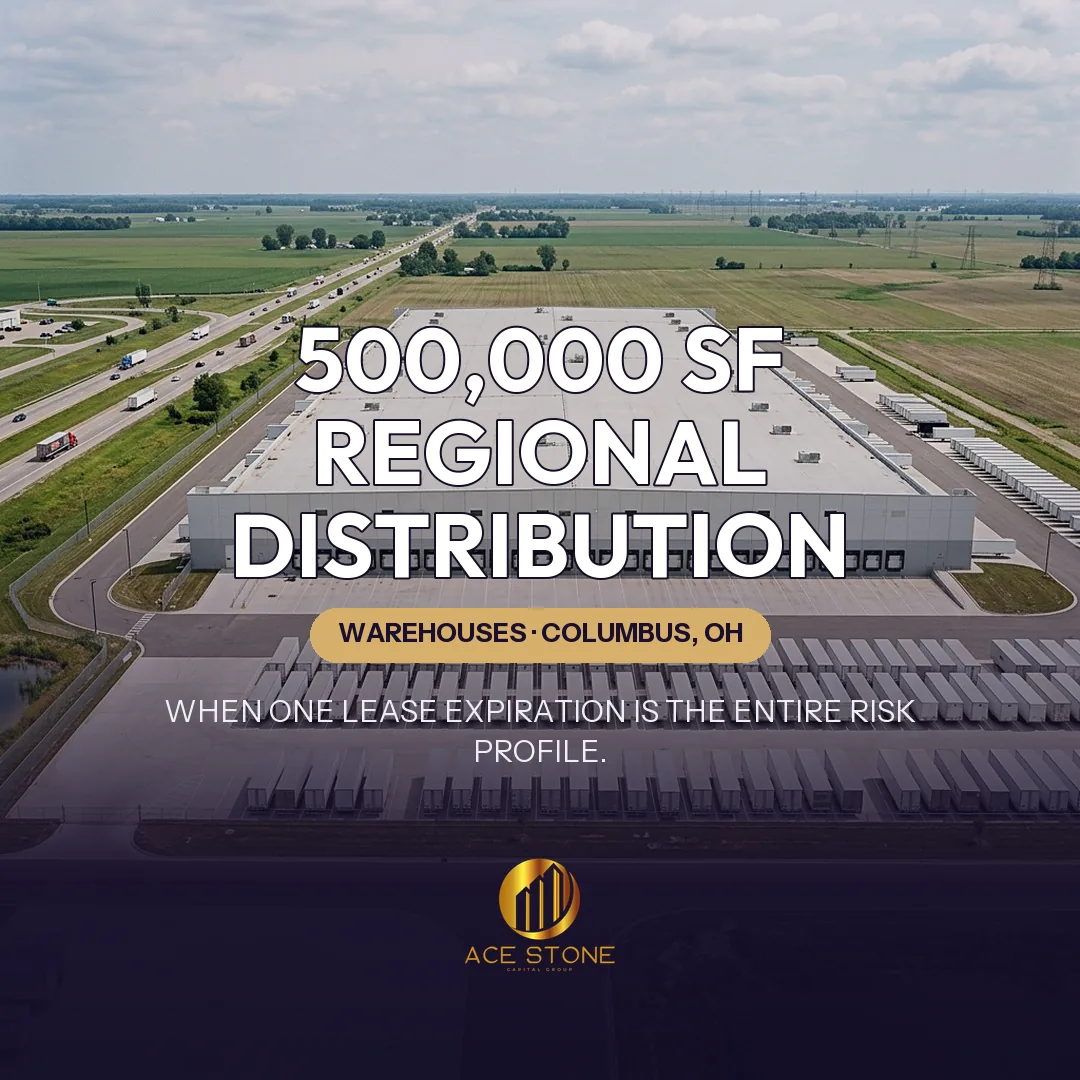
Representative imagery of the asset type and market — not a photograph of the subject property.
Case Context
This acquisition profile examines AceStone Capital Group's underwriting method for an asset of this type. Specific properties, counterparties, and pricing are not identified. The subject profile is a modern single-tenant distribution facility of approximately 500,000 square feet in the Columbus region, leased to one occupier with a defined expiration.
Executive Summary
At this scale the building is well specified, the location is logistically excellent and the in-place income is straightforward. The entire risk profile compresses into one date: lease expiration. A 500,000 square foot vacancy is not a larger version of a 20,000 square foot vacancy — it is a different exposure, with a smaller tenant pool, longer marketing periods, larger concession packages and a carrying cost that can overwhelm several years of accumulated income.
The regional distribution thesis rests on reach. The analysis measures the resident population and retail demand accessible within one-day and two-day truck service from the site, the interstate corridors serving it and their congestion characteristics, intermodal and air freight infrastructure in the region, and the concentration of competing distribution operations — which is evidence of the location's logic. Reach is what a regional distribution tenant pays for, and it is the most durable attribute the asset has.
Labour Market Assessment
For a facility of this size the availability of warehouse labour is a valuation input, not an operating detail. The analysis examines the working-age population within a reasonable commute, prevailing warehouse wage levels and their trajectory, the number of competing large facilities drawing on the same labour pool, and the availability of public transit or the practical necessity of driving. A submarket that has absorbed several large facilities in quick succession may be logistically excellent and operationally strained.
Specification determines the size of the replacement tenant pool. The analysis records clear height, column spacing, building depth, dock-high door count and the resulting dock ratio per thousand square feet, drive-in access, whether the building is rear-load or capable of cross-dock operation, trailer parking stall count, car parking count, truck court depth, slab specification, fire protection design and office ratio. Each attribute is scored against what current large-format requirements specify, because a shortfall on any single item can remove a facility from a tenant's site list before a tour occurs.
Trailer Parking and Yard
Trailer parking deserves separate treatment at this scale because it is frequently the binding constraint. Large distribution operations stage trailers as rolling inventory, and a facility with insufficient stalls forces off-site storage that adds cost the tenant will price into its rent. Yard depth, gate configuration, guardhouse provision, security fencing and the ability to expand paved trailer parking onto adjacent land are recorded as leasing attributes rather than site details.
Contract rent is compared with benchmark market rent for facilities of comparable specification in the submarket. Escalations, remaining term, renewal options and their pricing mechanism, recovery structure, and any landlord obligations for roof, structure and parking are documented. Where the lease was signed in a materially different rent environment, the direction and size of the mark-to-market at expiry is the single largest driver of exit value in either direction.
Renewal Probability
Renewal is assessed on evidence rather than optimism: the tenant's investment in fixed improvements at the facility, how central the building is to its distribution network, whether its operation is growing or contracting, whether alternative buildings of comparable specification are available nearby, and the cost and disruption of relocating an operation of this scale. High relocation cost supports renewal; a shrinking operation or abundant modern alternatives undermines it. The renewal probability that emerges is applied as a weighting across scenarios, not treated as a binary assumption.
The Asymmetry of Bulk Vacancy
In a multi-tenant small-bay asset, one departure removes a small percentage of income and is replaced from a deep local pool within months. In a 500,000 square foot single-tenant asset, one departure removes all income while the full expense load continues. The replacement pool is national rather than local and may number only a handful of active requirements at any time. Marketing periods extend over quarters, and the eventual deal typically carries substantial improvement allowance, free rent and commissions on a large square footage. That asymmetry is the reason the asset must be priced at a wider capitalization rate than its specification alone would suggest.
Downtime and Re-Leasing Cost Model
The vacancy scenario is modelled explicitly: a marketing period consistent with observed leasing timelines for comparable large-format space in the region, followed by lease negotiation and improvement work before rent commencement. Costs include taxes at reassessed value, insurance, security, maintenance, utilities to keep systems live, and the cost of capital on the full basis, plus the improvement allowance, commissions and free rent required to secure a replacement occupier.
Replacement Cost Discipline
Replacement cost sets the ceiling. Land at the location, current construction cost for a facility of this specification, site work including trailer parking, soft costs and a developer return are aggregated and compared to the acquisition basis. Buying meaningfully below replacement cost provides protection because a developer cannot profitably compete with the asset at that basis; buying at or above it means new supply can undercut the building whenever the market permits.
Scenario and Sensitivity Analysis
Four scenarios are carried: renewal at market on the expiration date with minimal downtime and a modest allowance; renewal at a rent below current market because the tenant negotiates from a position of scale; vacancy with a market-length marketing period and full re-leasing cost; and extended vacancy in a softer leasing environment. Each is flexed for market rent, exit capitalization rate and downtime duration, and the results are probability-weighted rather than presented as a single base case.
Exit Strategy
Exit value is dominated by remaining lease term at the point of sale. Selling with substantial term remaining attracts institutional income buyers at tighter capitalization rates; selling within a short window of expiry moves the asset to buyers pricing full vacancy risk, at a materially wider rate. The hold period is therefore structured around the lease rather than around a calendar target, and the model tests whether a renewal executed before sale materially changes the exit.
Acquisition Decision
On these underwriting assumptions the asset is investable where the basis sits below replacement cost, contract rent is at or below market so the mark-to-market at expiry is favourable, the specification meets current large-format requirements without exception, and the probability-weighted outcome including a full vacancy scenario still clears the return threshold. Pricing the asset on in-place income alone, without funding the vacancy scenario, is the error this analysis is designed to prevent.
Key Takeaways
In single-tenant bulk industrial, the lease expiration date is the risk profile. Score the specification against current requirements item by item, treat trailer parking as a leasing attribute, weight renewal on evidence, and price the full vacancy scenario into the entry basis rather than hoping the exit arrives before the expiry does.
What This Case Shows
A structured example of how AceStone Capital Group sources, underwrites, and structures off-market commercial acquisitions in Columbus, OH. For broader context, see our active acquisition markets or initiate a direct-sale review for a similar property.
Have a Property to Sell?
Receive a written offer or a clear pass within 1–2 business days.