
Back
    Commercial Columbus, OH August 2026

    Government-Tenanted Office: Pricing Security, Specialization, and Renewal Risk in Columbus

    A Columbus office building largely occupied by a public agency — separating durable income from durable real estate.

    This acquisition profile examines asset strategy, underwriting method, transaction structure, and value-creation considerations. Counterparty and pricing details are not disclosed.

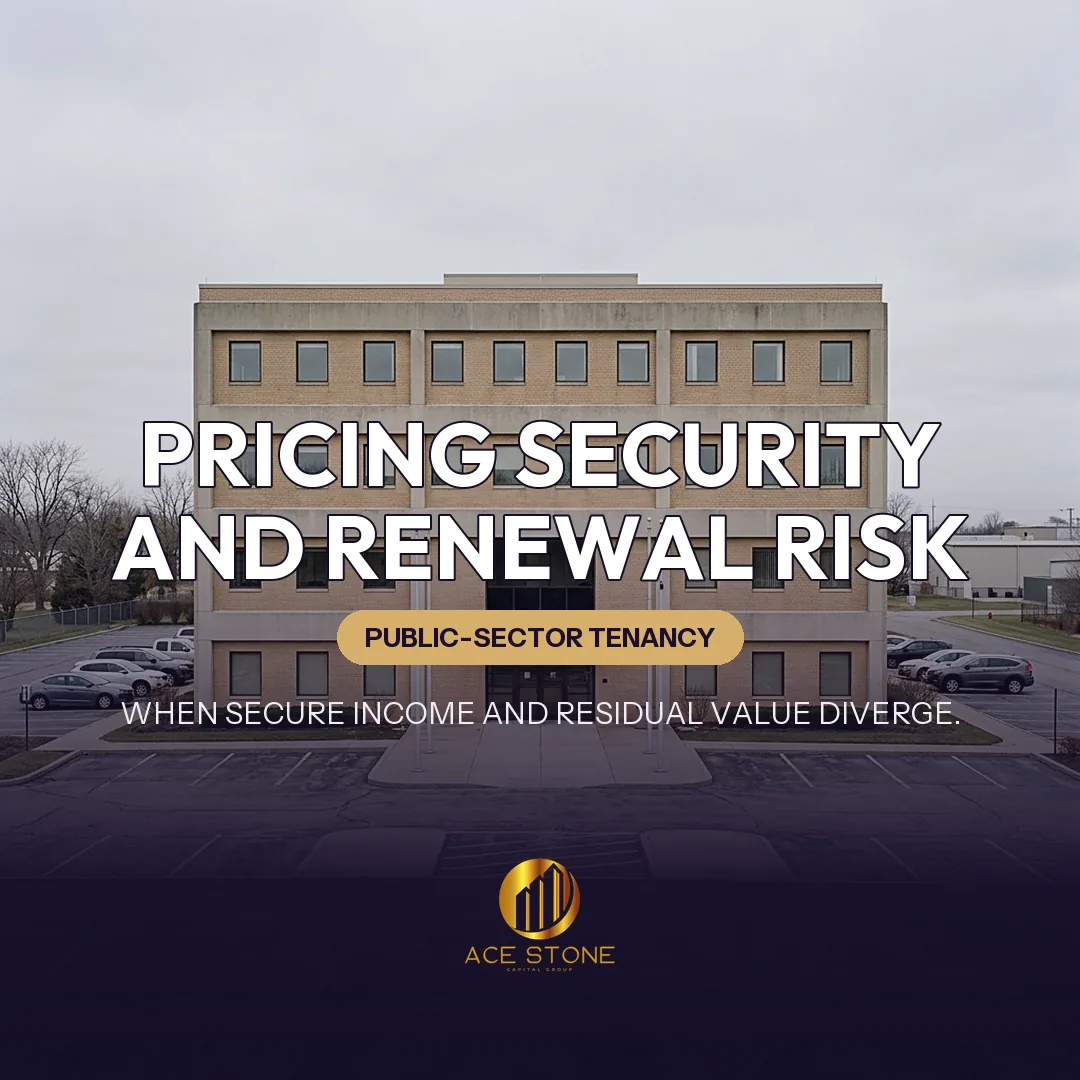
    Columbus institutional office building.
    Representative imagery of the asset type and market — not a photograph of the subject property.

    Case Context

    This acquisition profile examines AceStone Capital Group's underwriting method for an asset of this type. Specific properties, counterparties, and pricing are not identified. The subject profile is a mid-size Columbus office building substantially occupied by a public-sector agency under a multi-year lease, with a small balance of private tenancy. Public tenancy reads as the safest income in the office sector, and in the near term it usually is. The underwriting task is to determine whether the safety of the income has been purchased at the cost of the building's residual value.

    Lease Structure and Appropriation Mechanics

    Public-sector leases differ structurally from commercial leases and must be read on their own terms. The abstraction records the contracting entity and the authority under which it signed, the firm term and any non-appropriation or early-termination provisions, renewal options and how rent is determined on renewal, escalation or operating-cost adjustment mechanics, the treatment of taxes and insurance, holdover provisions, assignment and change-of-control restrictions, and any conditions attached to the landlord's ability to finance or sell. A lease that appears long-dated but contains an annual funding condition is a materially different instrument from a firm-term commercial lease, and the model treats it accordingly.

    Applied exampleSee how this played out in Why Industrial Land Is the New Core Asset — a commercial acquisition in U.S. Growth Markets.

    Landlord Obligations and Compliance Burden

    Public tenancy usually carries obligations a private lease would not: prescribed maintenance and response standards, cleaning and security specifications, accessibility compliance beyond the base code minimum, prevailing-wage or procurement requirements for landlord work in some jurisdictions, background-check and access-control conditions for vendors, reporting requirements, and audit rights. Each of these has a cost, and each reduces the landlord's flexibility to manage the property economically. The expense model prices the specification the lease actually requires rather than the market-standard service level.

    Specialized Improvements

    The building's fit-out is inventoried for use-specific elements: secure entries and screening areas, hardened rooms or evidence storage, public counters and queuing space, interview or hearing rooms, dedicated communications infrastructure, redundant power, camera and access-control systems, and unusual parking or vehicle requirements. These improvements serve the current occupant and typically serve no one else. Underwriting counts them twice: once as a reason renewal is likely, because replicating them elsewhere is expensive for the agency, and once as demolition and reconfiguration cost in the event the agency departs.

    Applied exampleSee how this played out in Retail Land in Secondary Markets: A Quiet Recovery Story — a commercial acquisition in U.S. Growth Markets.

    Income Durability

    During the firm term the income is strong: payment risk is low, occupancy is stable, and reimbursement mechanics are usually clear. That durability is the reason these assets price at tighter capitalization rates than comparable private-tenant buildings. The model captures it honestly — full collection, contractual escalations, and low turnover cost during the term — while flagging that the strength is time-limited to the term and any options the tenant, not the landlord, controls.

    Residual Durability

    Residual value is the separate and harder question. If the agency does not renew, the building enters the market as specialized second-generation space in a submarket that may have limited demand for its configuration. The analysis identifies plausible replacement users, the demising and demolition work required to serve them, the improvement allowance and free rent a competitive market would demand, and the absorption period. Where the answer is thin — a single-purpose configuration in a soft node — residual value can be far below the value implied by capitalizing the current income, and the gap between those two numbers is the risk being underwritten.

    Applied exampleSee how this played out in Mixed-Use Development Sites in Live-Work Corridors — a commercial acquisition in U.S. Growth Markets.

    Renewal Probability and Political Change

    Renewal likelihood is assessed on evidence: length of the agency's occupancy at the location, capital the public entity has invested in the improvements, the operational importance of the site to the services delivered from it, headcount trend, any published consolidation or facilities strategy, and the availability of competing space that could accommodate the requirement. Budget cycles, administrative reorganizations and remote-work policies in the public sector can change occupancy decisions on timelines the landlord does not control. Probability is applied to the renewal path rather than assumed at one hundred percent.

    Valuation Approach

    Rather than capitalizing net operating income at a single rate, the valuation separates the contracted income stream — discounted over the firm term at a rate consistent with the tenant's credit — from the residual value of the real estate at term expiry, discounted for time and re-tenanting cost. This structure makes the trade-off explicit. If the sum of those parts sits below the asking price, the buyer is paying a security premium for income while receiving a building whose next use is undefined, which is precisely the position that produces disappointing outcomes at exit.

    Exit and Buyer Pool

    Buyers for government-tenanted office are usually income-focused and term-sensitive. With substantial term remaining, the pool is deep and pricing is tight; with a few years remaining, the pool contracts sharply toward value-add capital that prices to vacancy. Any hold plan that involves selling with less term than was purchased must assume capitalization-rate expansion. The model reflects that rather than relying on a stable exit yield.

    Key Takeaways

    Public tenancy buys income durability, not real-estate durability, and the two must be priced separately. Read the appropriation and termination language, cost the specification the lease demands, inventory the improvements that serve only this occupant, and value the residual as if the agency leaves. Where residual value supports the basis, the security premium is a genuine benefit; where it does not, the premium is a liability with a date on it. Owners of comparable Columbus office assets can review the firm's acquisition parameters.

    What This Case Shows

    A structured example of how AceStone Capital Group sources, underwrites, and structures off-market commercial acquisitions in Columbus, OH. For broader context, see our active acquisition markets or initiate a direct-sale review for a similar property.

    Have a Property to Sell?

    Receive a written offer or a clear pass within 1–2 business days.

    Request a Cash Offer