Small-Bay Industrial Acquisition: Underwriting 28 Warehouse Units in Tampa
A 28-unit multi-tenant industrial park in Tampa, where diversified income and unit-by-unit rent resets are traded against real operational intensity.
This acquisition profile examines asset strategy, underwriting method, transaction structure, and value-creation considerations. Counterparty and pricing details are not disclosed.
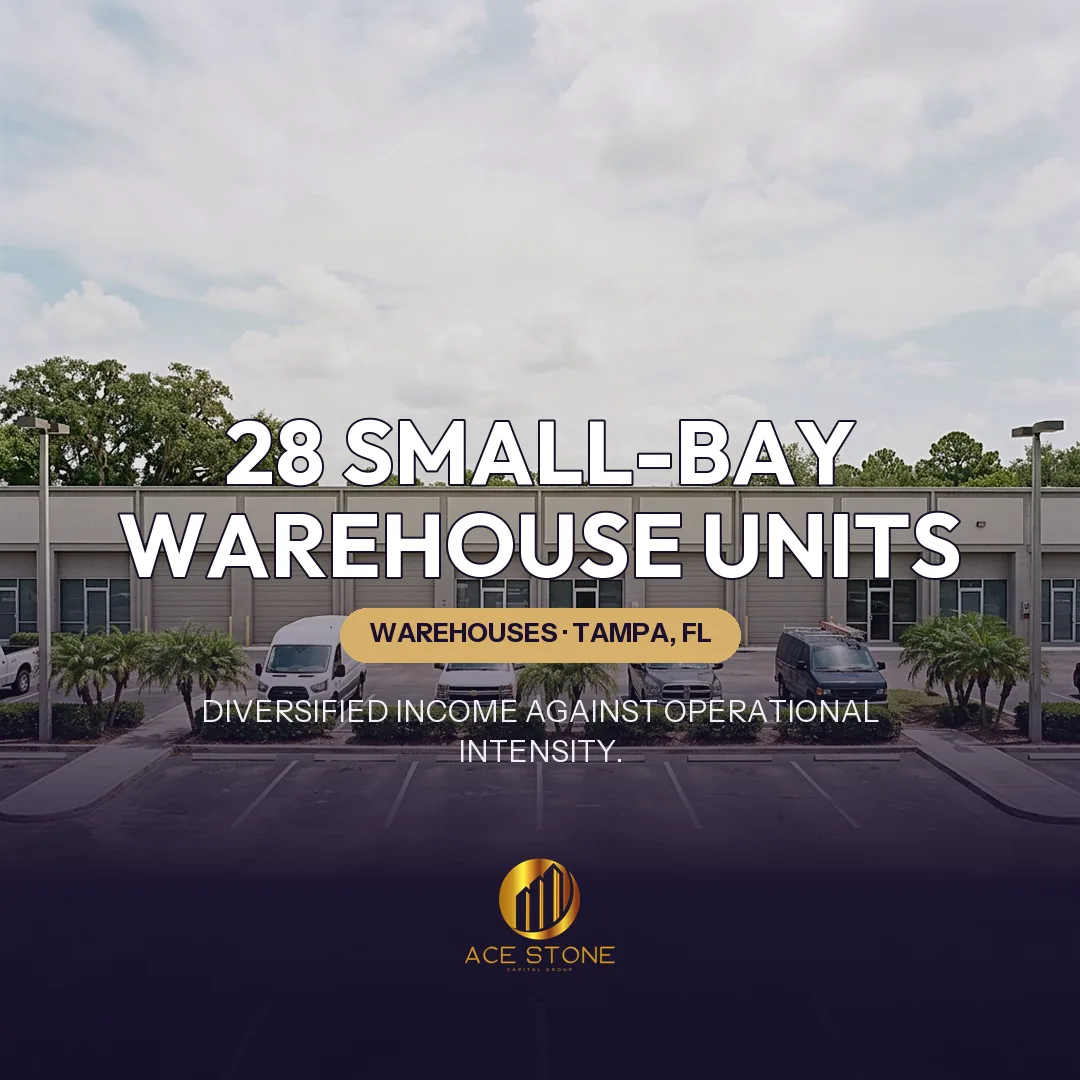
Representative imagery of the asset type and market — not a photograph of the subject property.
Case Context
This acquisition profile examines AceStone Capital Group's underwriting method for an asset of this type. Specific properties, counterparties, and pricing are not identified. The subject profile is a multi-tenant industrial park in the Tampa area divided into 28 warehouse and flex units occupied by local operating businesses.
Executive Summary
Small-bay industrial trades income concentration for operational intensity. Twenty-eight tenants means no single departure is material, rents can be reset progressively rather than at one high-stakes expiration, and demand comes from a deep local pool of businesses with few alternatives. It also means more leases, more collections, more turnover, more maintenance calls and higher management cost. The underwriting question is whether the rent gap and the diversification benefit exceed the operational drag.
The profile assumed here comprises single-storey industrial buildings divided into units spanning a range of sizes, each with a roll-up door, a grade-level or shallow dock-high position, a small office and restroom, and dedicated frontage parking. Clear heights are modest, bay depths are shallow relative to distribution product, and the site provides drive-around circulation with parking sufficient for vans and light trucks. Signage visibility and street frontage matter more here than in bulk industrial, because many tenants receive customers.
Tenant Base
The tenancy assumed is characteristic of the product type: contractors and building trades, service businesses, small distributors, equipment and vehicle operators, light assembly, and small operating companies using the space for a mixture of storage, shop and administrative functions. These are local businesses without corporate credit ratings, but with strong location dependence — their customers, employees and job sites are nearby, and relocating imposes real cost on them.
With 28 tenants, no single unit represents a material share of income. A departure reduces net operating income by a small percentage and is replaced from a deep pool, typically within a short marketing period, at modest turnover cost. The income stream behaves statistically rather than binarily: the model can assume an average vacancy rate and an average bad-debt rate with reasonable confidence, whereas a single-tenant building has no average — it is either full or empty.
Mark-to-Market Through Progressive Resets
Short lease terms, typical of the product type, mean a meaningful share of the rent roll reprices every year. Where in-place rents sit below market, that structure delivers the rent gap in controlled increments rather than in one event. It also permits calibration: if renewals at the new rate are accepted without resistance, the next tranche can be pushed further; if resistance appears, the pace moderates. This is a materially more controllable value-add mechanism than staking a business plan on one large lease expiration.
Each unit is analysed individually: current rent per square foot, term remaining, escalations, renewal options, recovery structure, deposit held and payment history. Market rent is established by unit size band, because small units routinely command a higher rate per square foot than large ones. Expirations are then mapped by quarter to identify any clustering that would force multiple simultaneous turnovers, and the mark-to-market opportunity is scheduled rather than assumed as a single stabilized figure.
Occupancy History and Turnover
Occupancy is examined over several years rather than at a single date, because a snapshot at full occupancy conceals a property that churns. The analysis records average occupancy, the number of units turned per year, average downtime per turn, and turnover cost per unit — typically cleaning, paint, minor repair, door service and a leasing fee. Multiplied across 28 units and a realistic turnover rate, these small individual costs aggregate into a meaningful annual expense that per-square-foot rules of thumb understate.
Credit, Collections and Bad Debt
Small operating businesses carry higher credit risk than corporate tenants, and the underwriting response is structural rather than analytical: meaningful security deposits, personal guarantees where appropriate, disciplined collection practice and prompt enforcement. A bad-debt allowance is carried explicitly rather than folded into a general vacancy factor, and the historical collection record is requested and reviewed rather than accepted as represented.
Management Intensity and Operating Expenses
The operating model requires active management: 28 lease relationships, frequent renewals, regular maintenance requests, tenant compliance with use and parking rules, and vigilance on outdoor storage and unauthorized activity. Expenses are modelled with realistic property management fees for the product type, higher repairs and maintenance per square foot than distribution product, landscaping and site cleaning, water and sewer where not separately metered, insurance at current Florida market pricing, and property taxes reassessed at the purchase price.
Capital Requirements
Capital planning covers roof by building section, pavement and drainage, roll-up door replacement across the unit count, lighting, HVAC in office areas, signage and exterior refresh. Roll-up doors deserve specific attention: they are the most frequently used and most frequently damaged component in small-bay product, and replacing them across a large unit count is a substantial programme rather than a maintenance line.
Scenario and Sensitivity Analysis
Three scenarios are modelled. The base case resets rents as leases expire at a moderate pace with normal turnover and downtime. The upside assumes stronger local demand supporting faster resets and higher renewal retention. The downside assumes a softer local economy affecting the contractor and trade tenant base, with elevated bad debt, longer downtime and rent resets that stall. Each is flexed for expense growth — particularly insurance, which has been a volatile line in Florida — and for exit capitalization rate.
Exit Strategy
Well-managed small-bay industrial attracts a deep buyer pool, including private investors and regional operators who value diversified income and the mark-to-market mechanism. Exit is modelled on stabilized net operating income after resets, at a capitalization rate reflecting the product type and the demonstrated occupancy history. A documented record of consistent occupancy and successful rent resets is itself a value driver at sale, which argues for disciplined record-keeping through the hold.
Acquisition Decision
On these underwriting assumptions the asset is investable where the price reflects the true operating expense load rather than a distribution-style expense ratio, where the rent gap is verified unit by unit against market rather than assumed in aggregate, where capital for roofs, pavement and doors is reserved at closing, and where a management platform capable of running 28 relationships is in place from day one.
Key Takeaways
Small-bay industrial is an operating business attached to real estate. Its diversified income and progressive rent resets are genuine advantages, but they are earned through management intensity that must be priced. Underwrite unit by unit, model turnover and bad debt explicitly, and never apply single-tenant expense assumptions to a 28-tenant property.
What This Case Shows
A structured example of how AceStone Capital Group sources, underwrites, and structures off-market commercial acquisitions in Tampa, FL. For broader context, see our active acquisition markets or initiate a direct-sale review for a similar property.
Have a Property to Sell?
Receive a written offer or a clear pass within 1–2 business days.