
Back
    Residential Dallas-Fort Worth, TX August 2026

    Suburban Mixed-Use Acquisition: Apartments and Neighborhood Retail in Dallas-Fort Worth

    A DFW town-center asset: does the restaurant and service retail component enhance the apartments, or simply add leasing risk to a residential deal?

    This acquisition profile examines asset strategy, underwriting method, transaction structure, and value-creation considerations. Counterparty and pricing details are not disclosed.

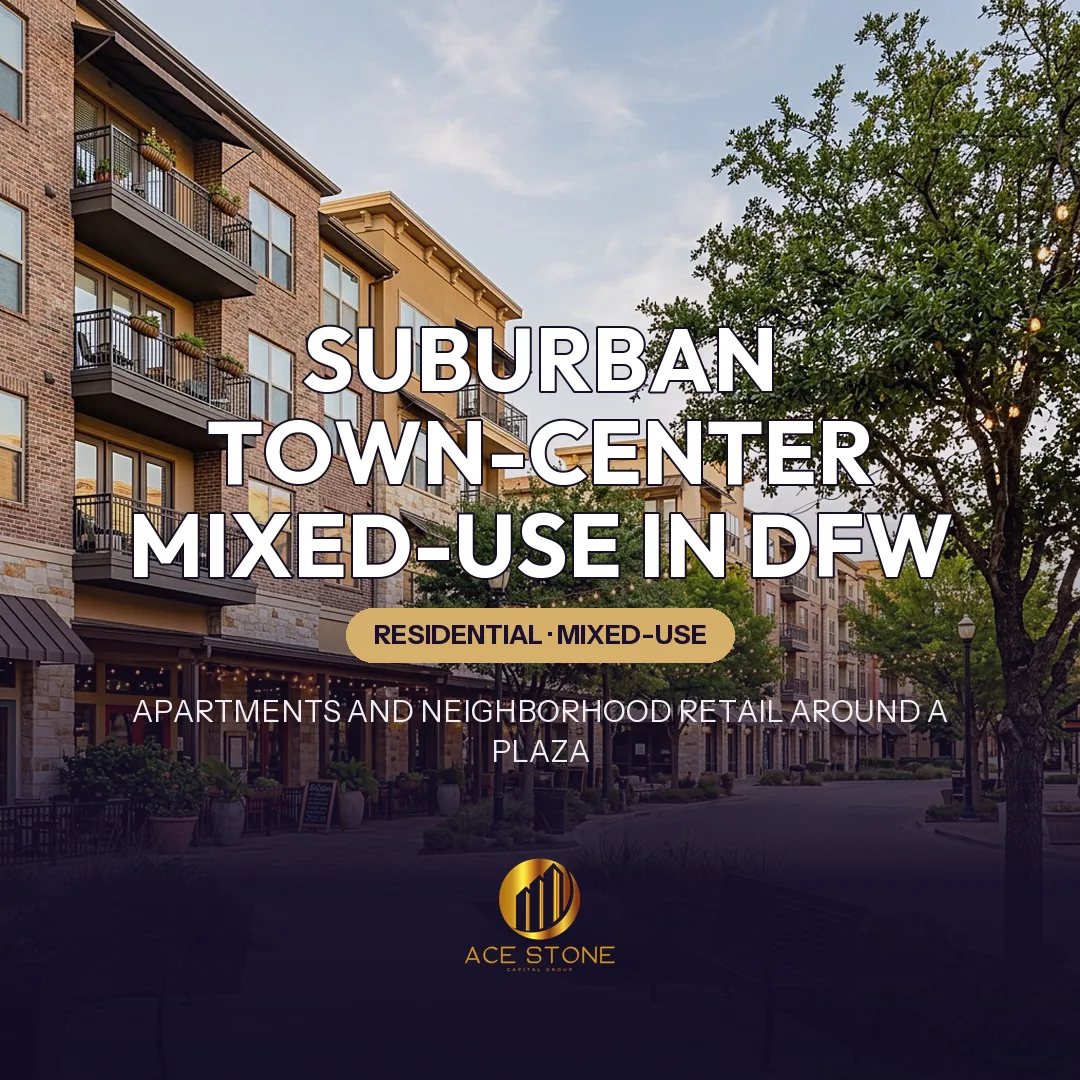
    Upscale Dallas-Fort Worth suburban town center with apartments above restaurants and a landscaped pedestrian plaza.
    Representative imagery of the asset type and market — not a photograph of the subject property.

    Executive Summary

    The subject asset is a suburban town-center property combining a substantial apartment count with a row of restaurant and service retail around a landscaped plaza. Residential income dominates. The analytical question is whether the commercial component earns its place — whether it raises apartment rents and retention enough to justify the leasing, improvement and management burden it introduces. Sometimes it does. Often the premium is smaller than the pro forma assumes.

    Case Context

    Acquisition profile. Specific properties, counterparties, and pricing are not identified. Figures are assumptions used to demonstrate underwriting method.

    Applied exampleSee how this played out in Why Infill Lots Are Outperforming in Growth Corridors — a residential acquisition in U.S. Growth Markets.

    Property Profile

    Wrap or podium construction, structured or surface parking, a mid-size apartment count across studio through two-bedroom layouts, and ground-floor commercial fronting a pedestrian plaza. Amenities include a pool deck, fitness room and coworking lounge. The commercial tier includes two restaurants, a fitness studio, a salon and a professional-services suite — the standard suburban mix, and one with predictable failure rates by category.

    Residential Performance

    Apartment occupancy, concession levels, renewal rates and trade-out data are examined over a multi-year window rather than a trailing quarter. The comparable set is drawn from competing product within the same drive-time and school attendance area. Suburban DFW supply is elastic; the model assumes new competing deliveries during the hold and tests renewal pricing power against them rather than assuming market rent growth applies automatically to the subject.

    Applied exampleSee how this played out in The Migration Effect: How Population Shifts Drive Lot Demand — a residential acquisition in U.S. Growth Markets.

    Retail Tenant Mix and Occupancy

    Each commercial tenant is assessed on category durability, operating history, guarantee structure and rent-to-sales ratio where available. Restaurants generate the plaza's energy and carry the highest failure and improvement-cost profile. Fitness and personal-service uses draw from a tight radius, which ties their performance to the same residential base that pays the apartment rent — a correlation that reduces diversification rather than adding it.

    Does Retail Support the Apartments?

    The premium attributable to the commercial component is tested empirically: rents and retention at the subject versus comparable apartment communities without ground-floor retail in the same submarket. Where the observable premium is modest, the commercial tier is underwritten as a standalone business that happens to share a parcel — with its own rate, its own reserves and its own risk. Where the premium is meaningful, it is credited to the residential income, not used to justify a tighter rate on the retail.

    Applied exampleSee how this played out in Path-of-Growth Markets: Where Land Appreciation Starts Early — a residential acquisition in U.S. Growth Markets.

    Parking and Common Areas

    Parking ratios must serve two populations with overlapping peak demand: residents in the evening, restaurants in the same evening. Shared-parking analysis, reserved-space policy and validation arrangements are reviewed. Plaza landscaping, lighting, seating, water features and event programming are real recurring costs, and they are frequently allocated in ways that quietly subsidize the retail from residential income. The expense model corrects that allocation.

    Expense Allocation

    Common-area maintenance is allocated by usage and area, with restaurant-driven costs — trash volume, grease handling, pressure washing, pest control, extended-hours lighting and security — charged to the commercial pool where leases permit and absorbed in the model where they do not. Management is priced as two functions, because apartment management and retail asset management are different disciplines with different fee structures.

    NOI and Acquisition Basis

    Residential net income is capitalized at the prevailing suburban apartment rate. Commercial net income is capitalized wider and reduced by a reserve for improvement allowances and commissions on the expirations inside the hold. Capital for exterior, parking-structure and amenity refresh is deducted. The result is the supportable price; a blended-rate calculation is shown alongside only to quantify how much the market's conventional approach overprices the asset.

    Tenant Concentration

    If one restaurant contributes an outsized share of commercial income, its departure is modelled explicitly: downtime, allowance, commission and the plaza-vibrancy effect on residential retention. Concentration is a pricing input, not a footnote.

    Exit Buyer Profile

    The likely exit buyer is an apartment investor who will discount the retail or exclude it from their preferred rate entirely, or a mixed-use specialist with a smaller bid pool. Either way, exit liquidity is a function of the residential component's quality. That reality argues for a basis set on residential fundamentals with commercial income treated as a supplement.

    Key Takeaways

    In suburban town centers, the retail is usually the amenity and occasionally the liability. Test the premium it produces, allocate its costs honestly, price its risk separately, and make sure the apartments alone justify the acquisition.

    What This Case Shows

    A structured example of how AceStone Capital Group sources, underwrites, and structures off-market residential acquisitions in Dallas-Fort Worth, TX. For broader context, see our active acquisition markets or initiate a direct-sale review for a similar property.

    Have a Property to Sell?

    Receive a written offer or a clear pass within 1–2 business days.

    Request a Cash Offer